Showing posts with label advice. Show all posts

Monday, 17 December 2018

TFP DMG: How To Run Combat

To my surprise and delight, there are people out there running my rules as-is!
This is wonderful, but also made me realise that I've got a lot of assumptions about how to run a game that don't necessarily come through!


Getting in Fights

The classic OSR rhetoric is to say that "combat is a failure state".
That is, the optimal tactic is to avoid combat at all costs.

This is true but let's be honest - violence is both inevitable and interesting.

Let's get into it!


Real Basic Assumptions


Let the dice run the combat.

Congrats! You've become a part of the audience with your players!
It's not your show any more, you're here to be an interpreter.
Sit back, relax, and get worried with your players when it looks like they're at risk.
Remember: It's not your fault. It's the dice.


Roll in the open.

Roll monster attacks and damage and everything in the open. It's fun, means you can't fudge, and shows newbies more examples of how the game works.
Plus the players get to celebrate or despair when they see what you just rolled with a big baddie.


Explain what you're doing.

Get into the habit of saying "this guy has 14 AC because his skin is like leather" or "this thing has a +4 to hit because it's got a whip-quick lashing neck like a snake" or "the poison bite gives you bleed poison equal to damage".
Not only does this help people understand how the game works under the hood, but their character can probably tell that a living statue will be harder to hurt than a robed tentacle cultist.


Simple initiative.

Simple, aka side-by-side initiative, is when each side (DM and player) has all their turns, then the other side has all their turns.
Roll 1d6 per side, highest wins, players win ties since I'm nice.
Not only does this speed up the actual game around the table and allow greater player cooperation, rerolling initiative each round has the added bonus of occasionally letting one side have two turns in a row.
Truly the easiest way to chuck balance out the window and watch it splatter on the pavement below.
There's little more nail-biting than an initiative roll when someone's about to die and facing down a massive hit from a big monster.


Be lenient.

Combat is messy. It's easy for a player to have a different idea in their head of what the situation is compared to you.
If someone says they're doing something, make sure of two things:
- The intent. What is the outcome they're hoping for?
- The consequences. What happens if it doesn't work out?
These are usually pretty obvious, but if you notice somebody trying to do something exceptionally stupid or impossible make sure you (and they) are on the same page.


Justify results retroactively.

Whatever you rolled, make up a reason why it happened! Or even better, work with the players to work out why it happened.
"These massive dragon jaws, this huge mouth comes down, about to bite you in half, and holy shit a fumble wait wait ok... it's stunned!?... what even happened here?!"
"THE SOUL OF ARACH-NACHA DID IT!"
Divining meaning from randomness is the heart of this game after all!


I give this handy combat option summary to Fighters, so they can be the ones who tell people how best to fight
Link.


Fuck it I stab him - Adjudicating Players in Combat

Violence

I've got three ways to resolve PC violence:
- Attack. Your classic roll to hit then roll for damage.
- Wrestle. For when they get in close and grapply.
- Gambit. Combat manouevres and other cool moves.

Attack.

Any time someone simply wants to make something die with their weapon, it's a regular Attack.

1d20 + modifiers vs AC. On hit, roll damage.

Players have got a fair few options for messing with the attack roll, mostly centred around weapon type modifiers (see Fighter handout above).
Also if multiple PCs are Flanking an enemy, they can roll Backstab on hit to upgrade it to a crit.
Most PCs only have a 1 in 6 chance of this, but Specialists and people who chucked in a point or two for Failed Career might bring their chance up.

One good thing about an Attack that might not be obvious is that you're not opening yourself up to immediate repercussions. If you Wrestle or Gambit you might get hurt on your own turn!

Wrestle.

Usually comes up when someone says "I want to stop her from attacking" or "I tackle them!", very useful for resolving PC-on-PC conflict where nobody actually wants to hurt each other.
Monsters love to wrestle too, so another common reason is "I want to get this off me!"

Contested d20 roll, melee bonus applies. Winner chooses Hold, Disarm, Brawl or Kick Away.
Hold: Try to pin them. Three Holds in a row makes them pinned and helpless.
Disarm: Snatch something from them, or throw something they're holding away.
Brawl: Deal damage with Small, Minor or natural weapons.
Kick Away: Kick them back in the direction of your choice.


One interesting thing to note is that since it's a contested d20 roll, wrestling effectively bypasses armour. The only exception is that Shanky weapons like daggers get a bonus Brawl attack if your Wrestle roll beats their AC - win or lose.
Sometimes it's better to wrestle an armoured foe and shank him in the ribs rather than keep plinking away at his armour, especially if he's got a larger weapon that can't be used to Brawl.

Since starting your go in a Wrestle means your only choice is to roll to Wrestle, it's also a real good option for locking down an enemy that might otherwise run away or attack a friend.

Once the Wrestle gets going you effectively roll twice a combat round - once on each wrestler's go. Since they're both at risk with every roll it makes things feel much more intense.

Gambit.

If they want to do something that's wacky/interesting/otherwise not covered by Attack or Wrestle, it's time to go to Gambit!
My table fucking loves Gambits. They're exciting!

Roll to hit twice.
Two hits - it works like you wanted it to!
Two misses - Ironic reversal, often the thing you wanted to do happens to you.
One hit one miss - partial success or success at cost (I tell you the options, you get to choose).


The advice above about intent and consequences is most important here.
Make sure you're clear on their intent. What happens if they succeed?
Make sure you're all clear on the consequences. What happens if they fail?

Once you're on the same page, say something like "ok so you'll do this if you succeed but this happens if you fail. Still want to do it?"

Sometimes there's a situation where you could adjudicate it as a Wrestle or a Gambit.
An easy example is a disarm - you could do that via a Wrestle (roll off, if you win you can choose to disarm) or via a Gambit (roll to hit twice, on success you've disarmed them).
In a case like this just ask them what they'd prefer, telling them the difference and the stakes.


Non-Violence.

There's a ton of stuff people can do that doesn't directly hurt, hinder or otherwise mess with the agency of others.

Much of the time you can just say "yea that happens". If someone wants to run away or use an item or whatever, just let them do it.

If it feels like there should be some chance of failure, like they want to do something super quickly or while they're in melee or are otherwise in direct danger, make them roll an appropriate skill.

I use Climbing for this fairly often. If there's a real difference in elevation, like you're on the street and want to get up to the fighting on the roof, I'll have you roll Climb to get up there in a hurry.

Even if it's something that seems impossible to do in a single round, like grab an oil flask and stuff a rag in it and light it, feel free to say it takes a few discrete rounds of actions.
In my game this often results in "fine I'll throw the oil and then someone else lights it" which is legit. Teamwork innit!
Also remember - Sleight of Hand to quickly do fiddly things is a legit way to use that skill.

Don't make it too much of a ballache to do non-violent stuff in combat!
The worst thing that can happen is that someone goes "oh fuck it whatever it's too hard, I just stab him" and just attacks instead of doing something more interesting or memorable.


It leaps at you! - Running Monsters in Combat


The main thing with running enemies is that generally you want to run them as quick as possible so the players can get back to making decisions.

What do they do??

You get all sorts of monsters with all sorts of bullshit abilities.
Make sure the powers are easy to adjudicate! Sometimes I'll make a monster and give them some cool fiddly power and oh no turns out I made them come in packs of 2d10 what was I thinking!?

I know Spwack has success with letting monsters use Gambits, but I don't do it personally.
That means monsters are either Attacking (probably with some bullshit monster ability) or Wrestling (monsters love wrestling, especially if they have teeth and claws and/or can jump great distances).

Don't be cagey about why monsters are doing what they're doing.
"It's protecting its master!" or "you hurt it last time!" or whatever.
Hell, if they're tactical enemies have them talk to each other about their tactics!
"Hit the wizard before she casts that spell!" or "stay at a distance from the one with the greatsword!", that sort of thing.

I'd reiterate a bunch of stuff about how to make "simple" monsters fun in combat, but again, some shithead did it better long ago.


Sidebar: Monster Wrestling

If multiple monsters gang up on one PC, they could be in trouble!
Since everyone rolls at once and the winner chooses what to do to one of the losers, it's hard to win and hard to kick them all off even if you do win!

Tying a PC down with a few little baddies is a good time, and if they've got Shanky weapons like knives they can all potentially deal damage by beating the PCs AC.


Who do they kill??

Sometimes you know exactly who an enemy is going for, like they're in deadly melee with a PC or they always go for the person with the least HP or they hate goblins.

Other times, I roll and decide why they did what they did after rolling.

A common phrase at my table is "high or low?", meaning that there are two potential targets and you've got to choose whether you're attacked on a 4-6 or a 1-3.
Roll the dice, see who they go for.

Sometimes I weight the results. "Ok you're down and no threat, but they might come to finish you off anyway because you killed their best friend. How about on a 1-2 they go for you and on a 3-6 they go for your friend nearby?"

If someone goes "hey no why are they attacking me?! Why don't they attack that guy?" then rolling to see who they go for is a good shout.


When do they stop??

When you:
- Kill them
- Make them stop
- Run away

Kill them!!

The obvious one! Kill them before they kill you!

I roll monster HP on Xd6+X, where X is HD.
Not necessarily for mechanical consistency reasons, I just have lots of d6s and the bell curves line up. If you've got enough d8s by all means use them!

I've got a couple of gimmicks with monster HP too.

If it's a gang of small enemies, like humans, I'll roll HP in the open after an attack hits them. If they survive, I put the die I just rolled on that enemy to show how much they've got left. (This is easy because I use pennies or other flat tokens for baddies).

For big beefy boys I roll all their HP behind a book or something, then as they're damaged I chuck the dice back into the box behind the screen to show how hurt they are.
It's fun to throw a few back when someone hits with a particularly meaty blow!


Make them stop!!

Morale is the main one! Roll on first death, when there are half left and/or when shit's starting to get slow and it's obvious the PCs are going to win.

Otherwise this is because my players have tried to initiate negotiations or something. If this happens just keep in mind what the enemy probably wants ("not to die" is a common one) and what they've got to bargain with.
I love a chatty baddie, so I'm usually open to this sort of thing!


Run away!!

When the going gets tough, the tough get out of there!
Chase scenes use the snakes and ladders minigame. I've got this on the back of the laminated marching order sheet, so I can flip it for chase scenes!

All you've got to do is work out how fast the baddies are on a scale from 1d10 (fast and light) to 1d4 (slow and clumsy). Since the maximum for an unencumbered character is 1d10, extra super fast enemies might roll on a 1d12.

Since the minigame is intentionally fairly abstract make sure to tie it into the fictional events! If the someone rolled really poorly or particularly well, make up why!


THE BEAST COMETH - Boss Monsters

I don't often use boss monsters. It's a lot of work for something that, if all goes to plan, dies and can't be used again.

But hey, I do them sometimes! Most recently with Elemental Dragons, and usually one-shots end with a big baddie.
Like that one time versus Santa Claus.
And that other time versus Trump.

Basically boss battles work best in a one-shot railroady format, so they turn up a lot then!

What I do use sometimes is a powerful foe with fiddly abilities - and isn't that what a boss monster is when you get right down to it. You don't want to have more than one or two fiddly foes in a battle!

The main thing to remember is that the players have almost always got way more actions and agency and attacks than a lone baddie, and mine have enough alpha strike potential to nuke a single target to the ground in the course of a single turn. Unintuitively, boss monsters are more vulnerable than a mob.
A boss monster that's just a big lone guy with lots of health is going to die.

So how to run them? Be aware of this. Give them abilities that allow them to be a threat outside of turn order. Make sure it's not just one meaty boi in a room - have them call for help.
Sometimes this can be a bullshit aura. Sometimes this can be immunities or resistances to certain attacks. Maybe they fuck with terrain, or have weird abilities that fuck with the players instead of the characters.

On their turn, try to change the battlefield a bit.
Smash characters around with a huge and powerful monster, pounce on the back rank with a fast and leaping monster, command the troops intelligently with a smart and tactical monster.

While your usual rabble might just act at random, give a bit of extra thought to boss monsters and other more complex creatures.
If they're chatty and can negotiate with PCs while they're carving them up, so much the better!


A Final Note on PC Death

Sometimes, a character will die.

For a PC death to feel legit it has to be:
- a consequence of player agency, and
- a known threat

If it feels like the PC had no choice in the matter, or couldn't have done anything to prepare for it, it feels cruel and arbitrary.

Look at Jon Snow up there. He made some dumb fucking choices and deserved to die for those choices, but they were his choices.
If it feels like you've railroaded a PC into a situation where they had no choice but to die, it's bullshit.
If the PC just dies out of nowhere and couldn't have discovered the thing that killed them, it's bullshit.

This is why it's important to telegraph traps, or at the very least telegraph that this is a place where traps are possible. 
It's also why my Death and Dismemberment rules are so complex, it means that you can survive a poorly telegraphed attack better!

Basically, make sure that if a PC dies it's their fault!

Tuesday, 9 October 2018

Putting G+ to Death

It's here. The death of Google+. Long prophesied.
To jump on the back of Chris' post here, even though I doubt I've got as much reach as him, here's some options.


GET DISCORD

We've got an OSR Discord. It's pretty chill.

MAKE BLOGS

There's a possibility that the scene gets more blog-heavy again, just like old times!
There's an OSR Blog Roll building up in Sheets, add your blog there. Contrary to what you might believe, the OSR blog scene is still pumping and there are new authors all the time, so get on it!
My blog roll on the sidebar there has a bunch of blogs, but it's hard to keep up!

FADE INTO OBSCURITY

There's a possibility that there will be a migration towards MeWe, another obscure social platform nobody cares about.
Is another obscure site the real way forward? Should we be worried about the weird free speech bent to the site? So many questions!
Anyway, I'm there as James Young for now.

GET ZUCCED

A number of people are on Facebook, but the signal-to-noise ratio in facebook groups is fucking abysmal. Either way, I'm James Young there too.

Monday, 27 August 2018

Three Ways to Solve Resource Tracking

Resource management can be a real fucking drag.
I'm going to call out the biggest potential drags here:

Food
Light
Ammo

The trifecta of trackables. Mundane, cheap, and not that heavy. Often handwaved or forgotten.
Luckily they represent three different ways of handling resources in my game!


Prepper culture is essentially adventurers prepping for a dungeoncrawl that'll never come


But first!

Some game design theory around resource management.

Resource management has come up a fair amount lately in the OSR, which is of course what triggered this post.
DIY & Dragons has a two-parter on resource management -- Part 1 and Part 2
Followed up by Scones Alone in this post.
And followed up in turn by DIY & Dragons again in this post.

Read up if you haven't already, but I'll summarise where I'm coming from:

- I like the idea of tracking mundane resources.
- I want it to be easy.


So

There are two main ways a resource can be used up.
Drain or Use.

Drain is when they tick down over time. Usually these are the mundane things.
At the end of the day, mark off a ration. After an hour, light a new torch. Tick tick tick. They drain away.

Use is when you make the active decision to use them up. Throw oil bomb to set a thing on fire! Drink a potion to get a magic effect! Read a scroll to cast a spell! Throw torch in pit to see how deep it goes!

In essence, "This is constantly dwindled to prevent a bad thing" vs "You can choose to use this for a Cool Thing."

Resources that drain are the ones that are boring to track and easy to forget if they're left solely to the player to manage.
I've never seen a player complain that they've got to keep track of three different potions, but I had players forget to mark off rations and ammo and stuff all the time.


These Rations for RPG Races are great if you haven't seen them!

Food

Solution A: Give an active use.

The troubling fact about rations in my game is that they're cheap and trivially acquired for any party that's gone on at least one adventure. As long as you're not on a long long road trip through the uncharted wilderness (a situation that's literally never come up in my game in over half a decade), they're not an interesting resource drain.

So I flipped it from a drain to an actively used resource.

There are two main uses for rations in my game:
- Heal in a dungeon
- Heal fast overnight

My players think about food a lot, and track it individually. It's the primary healing mechanic so of course it's important!
This is even before the new cooking subsystem which has made at least one player start tracking Standard Rations in close detail.

In practice this means that rations are a dungeon crawl resource replenished between delves. Run out of rations mid-crawl and you run out of easy healing, spend rations on the surface to get back down there as soon as possible.

Food tracking: SOLVED!!


Light

Solution B: Procedural tracking.

Players gain no advantage from remembering to track light sources.
That's the simple fact. Even if they're not doing it maliciously, the only reason for a player to track light is out of a sense of fairness.
So as with anything that sucks for the player, it's up to the DM to make sure it's enforced!

Trouble is, tracking light is kind of boring overhead and takes up valuable mental load.

My solution, courtesy of a primordial version of Necropraxis' Hazard System, is to track light on the encounter roll.


Torches burn out after two Torch Burnout results.
Lanterns burn out after four Lantern Burnout results.

The main advantage of this, for me, is that it becomes part of the normal procedure of play. 
It's not extra mental overhead to track, it's part of primary dungeon timer mechanic - random encounters.
This also introduces a level of randomness to light sources which I think works. Torches don't all last exactly an hour, fire isn't quite so predictable.

Light tracking: SOLVED!!


Ammo

Solution C: Ignore it

"Hey what? I thought this was meant to be solutions!" I hear you say.
Ignoring it is a solution my friend. Tracking normal ammo is the worst.
It feels like it should be important, but in practice it's really not.
It feels like it should be interesting to run out of ammo, but in practice it's not either. You just stab instead, or get creative with random junk in your inventory.

My players simply don't make that many ranged attacks - they avoid combat if possible, shooting into melee has a high risk of hitting a friend, and most of them have firearms that take too long to reload mid-fight.
I even tracked ammo with a Usage Die for a few years and nobody ever got low enough on ammo for it to matter. C'est le jeu.

So - just ignore it. A few ranged attacks per session isn't enough to worry about really.
Having a quiver or ammo bag or whatever has an encumbrance penalty, so there's a small but notable downside to having a ranged weapon already. It's fine.

Ammo tracking: IGNORED!!


Solutions

So there you have it - three different ways to solve resource tracking.

A: Give it an active use.
Make it important enough to track actively, just like potions and spells and HP and all the rest.

B: Procedural tracking.
Track it through a game mechanic, ideally rolling it into some other procedural thing you already do.

C: Ignore it.
If there's never any real risk of it running out, just don't bother.


Ammo 2: Bonus Spitballing

In writing this I was wondering if there was a better solution to ammunition.
Ignoring it is a fine solution but inherently fairly unsatisfying when you could be the first person to come up with a Rad New OSR Mechanic.

So there are two other options if I want to stop ignoring ammo - give it an active use, or procedural tracking.


A: Active use would be the obvious one. Rather than spend an ammo to make a ranged attack, why not spend an ammo to give that ranged attack a boost?
So like:
Bow - Rapid Fire - Spend an ammo to roll damage twice and take the best.
Gun - Overcharge Round - Spend an ammo to deal exploding damage on evens.

But then this could be covered by magic ammo and trick arrows and such. Just give them the option to buy Overload Cartridges or Dum-Dum Arrows and they'll track them religiously.
Plus I already use Gambits for doing cool stuff with mundane attacks, making this concept unnecessary.


B: Procedural Tracking is the other side of the coin. Perhaps roll ammo depletion into the attack roll.
If rolling a 1 on an attack roll means you've run out of ammo, that works out to an average of 20 arrows per quiver which is bang on.
But then you run the risk of a real dumb situation where your first shot from a fresh quiver is also your last.

You could give each ranged weapon 3 Ammo Boxes and a Depletion Range, so a quiver of arrows checks off an Ammo Box on an attack roll of 1-3 and a bag of sling bullets only checks off an Ammo Box on a 1.

I'd definitely use this myself, only it doesn't solve the initial point that my players just don't make that many ranged attacks! 


Encumbrance

A final note on encumbrance - writing this post has made me realise just how important encumbrance is as a limitation for mundane items like these.

There's no real limit to how much food, light and ammo a party can carry in the overworld. Any party that can afford a cart, a barrel of iron rations, and a pile of torches can park up next to a dungeon entrance and be set for weeks of delving.

The only limit is how much you're going to take into the dungeon with you. 
Are you going to be slow and prepared? Or are you going to travel fast and light? If you're wearing heavy armour are you willing to slow yourself further with bags of rations and jars of lamp oil?

Being slow means you face more encounter checks, so the feedback loop of resources-encumbrance-encounters is important if you want mundane resources to be an important choice.

Which is to say - if you handwave encumbrance and/or don't use random encounters there's no point tracking mundane resources. 
It seems obvious when I say it like that.

Saturday, 28 April 2018

Putting Your World to Death

I hope, for your sake, that your world has a good long life ahead of it.
But if you've suddenly found yourself dealing with imminent apocalypse, hopefully this will help you set up the fall.


A note for my players: Possible spoilers ahead. I don't think there's anything suuuper major in here that will ruin stuff, but read at your discretion.


The Impersonal Apocalypse

First things first - some context.

Mine is an impersonal apocalypse. Shub-Niggurath is a huge but non-sentient creature that is breaking out of the world. It will shatter the world like an egg. It doesn't think. It does not, and cannot, care about this.
Similar might be the sun going out, or a meteor coming to destroy the Earth or Cthulhu rising. Nobody caused this. It's nobody's fault. It just is. And now we've got to deal with it.

This as opposed to an apocalypse caused by something with an actual will and sentience, like Sauron or Thanos or a generic Ancient Evil That Has Awoken. There's always the slim possibility that you can reason with or trick such an entity. At the very least you can murder them or seal them away or whatever.

This doesn't change the following post all that much, but it's maybe useful for context? Anyway.


Faction Endgames

Your first task is to work out what your campaign's main factions are going to do now. How do the existing factions react? Are there any new factions brought forth by impending doom?
It's the end of the world. The world ending is bad for everyone. Who's trying to stop it and how are the planning to do it?
And most importantly - how do these plans oppose and clash against each other?

I've got three general spheres for how factions are reacting to the rise of Shub-Niggurath:
- Save humanity at all costs.
- Save the planet at all costs.
- Save the universe at all costs.

Examples:
The Apocalypse Dragons are here to save the universe. They live and act on timescales so vast that the spread of a planet-cancer across the universe over aeons is a real and present threat. They will destroy the world and all life on it if it stops Shub-Niggurath from spreading.

The Necromantic Duvan'Ku are here to save the planet. They're willing to sacrifice as much of humanity is necessary to ensure the planet's survival. After all, it's not like they'll kill off the trees. In a worst case scenario "living" as Undead even after everyone else is dead and gone.

The sin-eating Demons, perhaps counterintuitively, want to save humanity. They feed on sin, and if there are no sinners left then they'll starve. If they found a way to save humanity at the expense of the planet and the wider univere, they'd do it.


The key to all this is that every faction has good reasons for doing what they're doing. They're generally all doing what they think is right and for the greater good, but also with a level of self-interest that can clash against some factions and align them with others.
Their reasons and motivations might be different, and there's a lot of conflict depending on what time scale they're working on and what they personally value, but each faction thinks they're the good guys willing to do what it takes to save what's important to them.

There's an extra layer for my game because I've got players who've been in the same campaign world for literal years. These factions are known.
They've got all sorts of friends and enemies in the world. There are even recurring characters wandering around who some players recognise from previous adventures with previous characters. It's intense! The joys of a long-running game!
Now suddenly all the factions have shifted to their final endgames and it's really kicked the game into a higher gear. With that game history on their side, the players have enough of a grasp of the game world to really work out how they'll make an impact.


A Note on Agency in a Dying World

Players have a lot of agency in a world that's fairly fucked up.
I think it's because you can really see the cracks. Who do you help? Who do you oppose? Who do you exploit for personal gain?

A sandbox game needs roguish, pragmatic, self-motivated characters to work properly. There's a lot of stuff for characters get roguish and pragmatic about when everything's falling apart.

And when every faction is doing bad things for the right reasons, it gives a lot of solid reasons for players to support, oppose or unite various forces. It's pretty cool!


Apocalypse Timeline

This is your second task.
Decide how long the world has to live. For me, I gave them just over a year.
Shub-Niggurath began rising in November last year, it's going to crack the planet in December this game-year.

Now it's time for the fun part - make a calendar of what each faction is doing each month!
You'll be updating this timeline as and when players mess with the course of events.

Since we're past this point in the timeline now, I suppose I can show you at least this much.

Players may not want to expand

The idea with this is to make sure you know what the big movers and shakers are doing, especially in the case of players just jumping up and heading off somewhere new. Gives you something to work around!
It also means that when players do something of real significance, you can work out how they rebounds and impacts different forces in the world.
My intention is to release each of the things by the end of the month, but I'm a little loosey-goosey on the exact timings. Preferably the players are on the surface to witness such things when they happen so I miiight nudge the dates along a little bit to make it a bit more cinematic.

Deep Carbon Observatory has a similar sort of long-range timeline thing that happens if PCs never influence events, so this is definitely in that vein.


I really wanted to use apocalyptic events from Revelation to get that good fucked up apocalypse feel. Evangelion influence again, probably.
Seven Trumpets, Seven Vials, all that good stuff. Combine with all the other various swirling ideas and themes, shake, and strain over ice.
So far it's all lined up weirdly nicely. When the First Trumpet was due to sound I looked around to see what could have kicked that off, and conveniently one of the players had managed to set the table for me!
They gave the alchemist who wanted to create a Shub-Niggurath-destroying omnipoison a sample of extremely powerful demon spider poison. The alchemist tried it out, it went wrong, and now there's no grass and cancerous tentacles and a third of all flora has withered and died. How prohetic!

I don't care I loooooove big fuckoff indestructible natural disaster dragons

End Times Encounters

The third task is adjusting your encounter tables for this new reality.

One thing I'd say - don't weight the results via multiple dice in the apocalypse. 
I've moved all my end times encounter tables from 2d6 to a straight 1d12 so all results are equally common.

Having a weighted 2d6 is for conservative simulation of a fairly dependable ordered world. Common local encounters go in the middle numbers, doom-wizards and elemental dragons go on the rare numbers. Having a straight 1d12 roll means you see the doom-wizard as often as you see anything else, which works for the chaotic terror of the apocalypse!

The other thing I've done with a number of Lair results is to put them in conflict with "Roll Again", so there's going to be much more naturally occurring conflict in the overworld. It's the apocalypse, everyone's fighting everyone else, dark times for all really!
Seeing two sides in battle is perfect for a Lair result. The encounter is close and the players can easily engage if they want, but they can also go the other way and avoid the situation.


Information and Agency

Players need information to make informed choices.
Making informed choices is Agency.

I've been honest with players about when the world is set to end, ie. December 1601.

I figure we've all played enough games where the apocalypse is juuuuuuuuust about to happen, but you've got plenty of time to run around doing some final side quests before actually triggering the final mission.
(Looking at you, Mass Effect)

By giving a set end date I'm saying that I'm legit about letting the world die. GOOD LUCK!

There's already a sense that they're going to have to be reeaally careful about using time-advancing mechanics like Carousing or Spell Research. I'd previously made those things take a while simply so that the game timeline advanced sorta kinda at a pace with real time. 
Suddenly downtime is recontextualised from a straight money sink to a real risk/reward mechanic.
Do we risk spending a week or so partying to level up? What if something terrible happens in the mean time?

I've been stocking up the Rumours table with more news than before. I've de-emphasised hints at nearby dungeons. The players know which dungeons are important now. Instead the rumours tend to be about wider events in the world, and hints at the sort of threats that are becoming more prevalent in the overworld.
Rumours about what's happening on the front lines against the Dead, updates on the movements of Battlefortress Fate, etc etc.
Gameplay is necessarily moving up to a grander scale, so the rumours reflect that. Nobody cares so much about Granny Questgiver's lost cat when there are literal angels falling from the sky.

Be liberal with the information you give out. Nobody's cagey in the end of days! Everyone anyone meets is going to have some story about something major happening somewhere, so let it happen!


In Closing

The end of the world is an exciting time. Embrace it!
I like to think my game has always had high stakes, but that's often been in the context of character life and limb. Suddenly world-saving stakes have shifted my game to another gear!

No matter what the outcome, I imagine the aftermath of the apocalypse is going to gear-shift my game again.

Hexcrawling and rebuilding a shattered world? Space voyagers flying off on shattered fragment of Earth? Time-fucking attempts to rewind and rewrite history?
I'm excited! And if your world is ending, you should be too!

Monday, 14 August 2017

Improving Your Encounter Tables With Gimmicks!

Encounter tables are the lifeblood of my game.

Overland encounter tables are probably the single most reusable thing you can make, make it once and just use it over and over forever, and the steady beat of the dungeon encounter roll is the time pressure that penalises overcautious parties.

I mentally divide encounter tables into vague categories - Dungeon, Overland, and City.

So here's some tips.


Dungeon Encounters

This is based on Brendan Necropraxis' Overloaded Encounter Die aka the Hazard System.

I assume you know how to stock a dungeon encounter table - just put whatever you'd find on this dungeon level in the table, plus maybe a homeless wandering beast or two and some scouts from the next level of the dungeon.

Roll the Encounter Die every 10 minute turn. In my game I track this fairly loosely. Down long hallways I might start eyeing up squares and movement rates, but this usually gets rolled any time the party stops to investigate a room, messes around with the scenery, or they Take a Break to eat and heal.
"Are you guys aware that this will take long enough to need an encounter roll?" is something I say whenever somebody wants to spend time poking around a room.

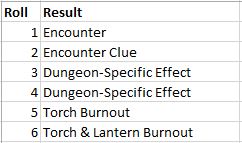
Anyway, the Encounter Die results are as follows:


1. Encounter
Your classic encounter. Roll number appearing, make a Reaction roll, roll Surprise if necessary and go.
In a dungeon it's usually quite easy to make up a reason for what they're doing there based on the surroundings and/or the party's recent activity.

2. Encounter Clue
Roll for an encounter, but give a clue about what's out there instead.
Maybe they hear it growling, or voices down the corridor, or see a silhouette in the distance. Corpses are good too, whether it's of the encounter creature or one of its victims.
Basically just make something up that gives an impression of what's out there.

3 & 4. Dungeon-Specific Effect
This is the big one. Effects are on a per-dungeon basis and supposed to give some unique character to the locale.
A more dangerous area will have more directly dangerous results, while a safer area might simply be set dressing.

In the Spooky Dungeon, 3 might be "Chill up your spine! Hirelings check morale." and 4 might be "ankle-high fog floods through rooms and corridors, hiding anything on the ground this turn".
In the Earth Elemental Dungeon you could have "Earthquake! Save vs Stun or fall to the ground! Unsecured objects jostle and fall" and "Floor becomes a muddy quagmire, halved movement this turn".
The Tentacle Dungeon had "Distant groaning and shuddering sound, denizens distracted by the great tentacle's sermons this turn" and "Questing tentacle slithers through room, will summon enemies if disturbed".

Basically put a couple of interesting environmental effects in this category. Between these results and the encounters, different dungeons will hopefully feel very different from each other.

5 & 6. Light Source Burnout
Torches have two checkboxes. Lanterns have 4 checkboxes.
On a 5 or 6, tick off a torch checkbox.
On a 6, tick off a lantern checkbox.

This means that, on average, torches last 6 turns (1 hour) and lanterns last 24 turns (4 hours). Just like they're meant to! Plus there's some variance in how long they last. How lovely.


Overland Encounters

You can do a lot of messing about with Overland encounter tables.
The beating heart of my overland encounter tables is this absolutely inspired Procedure for Wandering Monsters by John Bell.
The core innovation is that you have a standard table of encounters paired with a sliding scale of severity. You roll for encounters and also roll a d6 for severity.
If players are up for it, they can keep track of the numbers rolled so they can predict what's out there.
You end up with something like this:
Click to Expand - or Drive sheet here
As you can see, each Encounter also has an entry for Lair, Spoor, Tracks, Traces and Traces/Benign.
This is explained at the link, but I'll reiterate how I do it here for ease of access.


Severity


Encounter: Your classic encounter. You basically stumble right into the situation, or they stumble into you.
Lair: Either an actual lair, or a situation where they're real close. Either way, you might be able to avoid an encounter if you take immediate action.
Spoor: They're real close! Encounter easily avoided, but also easily approached.
Tracks: Evidence that something's been past here recently. You can usually follow the tracks if you want.
Traces: Some evidence pointing to the existence of the encounter in the area.
Traces/Benign: Some more evidence or, if I can't think of anything, some vaguely on-theme set dressing.


Weighting Tables

You likely already know about bell curves, where the average result of two or more dice is most likely to occur. On overland encounter tables I usually use 2dX, so it's weighted towards the middle of the table, and put the most common encounterables there.

The clever thing you can do is vary what you roll on the table to get some variation within the area.
Maybe you don't want the elven forest to be completely homogenous, and want to weight it so there's more magic treant stuff near the centre, and more natural normal stuff near the edges of the forest.
Maybe you want the Dragon to only be found near its lair on the east of the map.
Maybe you've got two factions in the area and you want more of one faction to be around their base in the north, and more of the other around their base in the south.
You don't need to break the area into smaller zones, just vary what you're rolling.

There's two main ways I do this:

Roll Different Dice
Down the bottom left of the encounter sheet image above, you'll see that the dice rolled on this encounter table change based on how dangerous the area is.
This table is for the Contested Farmlands area of my map, where man and necromancer alike are still dealing with the aftermath of Death Frost Doom.
In the safer areas close to cities and on main roads you only roll 2d6, limiting the results to the safer lower end of the table.
As you go deeper into unsafe territory, you roll 2d8 and then 2d10, increasing the scope of possible encounters and making the result more likely to be undead-related.

Roll+X
The other way I weight tables is to just add something to the roll.
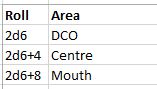
On my River encounter table I wanted encounters to shade between the weird creature infested Deep Carbon Observatory aftermath at the top of the river, and the less fucked up area at the river mouth.
This means that results 2-5 can only be found in the DCO area, and results 17-20 can only be found at the rivermouth. So this is where you put the big rare stuff that's very specific to those areas, like a big ol' age of sail galley at the river mouth, or a big ol' Giant Cuttlefish around DCO.
Everything in between can be found further away from that main starting point.
Remember, the average roll also changes this way, so result 7 will be very common in the DCO area, rare in the Centre and, and not seen at all at the River Mouth.


Using Excel for fun and profit

Excel is fucking great, and you can do a lot of encounter table automation with it.
I'll go into the wacky world of automated subtables in the City Encounters section, but for now allow me to tell you a really simple trick.
You'll want to grab a copy of this sheet.

The main trick is RANDBETWEEN, aka the Excel diceroller.
=RANDBETWEEN(1,6) will roll 1d6.
=RANDBETWEEN(1,10)+RANDBETWEEN(1,10) will roll 2d10.

The other trick is that you can chain text into a formula with & and quotation marks.
="Ghouls ("&RANDBETWEEN(1,12)&") led by a Ghast" will give you Ghouls (1-12) led by a Ghast.

Thus endeth the lesson.


City Encounters

The trouble with towns and cities is that I want to make the district/borough/area unique, but also allow each district to be part of a cohesive whole.
So unlike, say, having a different encounter table for the Forest and the Mountains, or rolling different dice in different areas of the Forest, I want one that has a fair amount of overlap while also giving each area its own flavour.

First you want to split the city into zones. In Moondin, a town that was in the middle of riots, I had a central Anarchy Zone and several other zones under the control of various factions.
My campaign map's capital, Fortress-City Fate, has 12 main districts arrayed like the face of a sundial. Each district is defined by the sort of businesses or housing that the area is known for.

Rather than have a separate encounter table per district (too much effort), we're going to have table entries we swap out per district. The other results will be permanent fixtures or subtables that remain the same no matter where you go.

Here's the encounter table for Fortress-City Fate. It's the most complex one I have since it's the most important city in the country, and players can get embroiled there quite easily.

Drive link here if you want to check it out, you'll have to save your own copy though!

Man that's a lot of subtables and lookups!
It's all automated on the actual sheet, but this calls out what each thing means.
Cells highlighted in yellow point to subtables for things you'll see or experience in any district of the city.
Cells highlighted in blue are swapped out depending on the district.

The encounter roll at the bottom is the equivalent of the overland severity roll, just more loosely defined and city-related.
Clash between two encounters (result 3) isn't necessarily a fight, just one result affecting another.


District Differences

The blue-highlighted per-district results are the most important part.
My hope is that players who get lost, or find themselves popping out of a manhole somewhere after a deep dive into the undercity, might be able to work out where they are based on these.

For instance, Result 7 is "Common Local Encounter", which is the population you'll see most often in an area. It pulls from the following table:


So in the Lower Class district you'll often see money-grubbing urchins, while in the Learning district you'll come across lots of boisterous students.
Bear in mind that if the players look around they'll probably see these types of people, rolling them as an Encounter just means they're directly notable.


City Subtables

The yellow-highlighted cells are subtables for things that can happen anywhere in the city. This could be because it's a more generic result (like thieves), something that could happen anywhere (like a cart crash) or something that affects the entire city (like a rainstorm).

As an example, here's the City-Wide Event subtable:


This stuff could happen anywhere. You may notice that some results are from Vornheim, steal from it liberally!


Excel Again

You can automate this whole process with Excel. Rather than flipping between tabs or physical pages to use subtables, you can just pull everything into the one front page.
As an example of the final result, check these out.

Entertainment area

Middle Class area

If you already know the wonders of VLOOKUP (or its mighty brother, Index Match) then you have finished the blog post! Congrats!
For those who don't, you were going to have to learn one day.

First, make a table. Numbered first column, results in second column. Standard D&D stuff.

Second, set up your auto-roller with VLOOKUP. To our D&D-trained eye, the formula looks like this:
=VLOOKUP(Die Roll,Random Table Location,Column,FALSE)

Replace Die Roll with our good friend RANDBETWEEN. As in the Overland Encounters section, this is the Excel dice roller.
RANDBETWEEN(1,6) will roll 1d6.
RANDBETWEEN(1,10)+RANDBETWEEN(1,10) will roll 2d10.
Adjust to however many "dice" you want to roll on the table.

Replace Random Table Location with the coordinates of your table. 
If your table is between Cell A1 and Cell B10, this will be A1:B10.
Usually you just click and drag over the area.

Replace Column with 2 for a simple two-column table. This means that we'll get the result from the second column, ie. the results.

Keep FALSE as is. It needs to be there for some reason.

And voila! Your very own hands free in-Excel dice roller and results-giver.
Top tip: you can press F9 to reroll.


That's all folks

There's a bit of extra Excel bodgery going on in the Fate encounter table, but it's mostly based on VLOOKUPs. Feel free to poke around! If you need a hand, send me a message.

Tuesday, 18 April 2017

Running for Big Groups

Update: For an audio version of this article, go to Blogs on Tape!


Since early 2015 I've been running for BIG GROUPS more or less constantly. We usually hover around 7-10 players per session.
This is great (since I never run into problems with not enough people showing up, a holdover worry from the shaky early days) but difficult to manage if you're not used to it.

This boat battle had 4-5 different mini scenes going on at once involving 8 players, it was awesome


So here are some tips.

Running the Game

Tell them to speak up
Possibly the most important, and something I learnt from Courtney when I was in one of his big hangouts games.
Make sure you stress that a big group is ok but you need people to speak up if they want to do something. Players want to be involved, so let them help you!
With this many players, it's not worthwhile to concern yourself with how much "spotlight time" people are getting. It's going to have to be up to them to seize the spotlight, and up to the group to give them that spotlight if they're not a natural spotlight-grabber.
Just keep an eye out for people who seem like they're about to say something but get interrupted by a louder voice. A quick "hold that thought" is usually all you need so you can circle back round to them.

Be lenient
Alex Chalk states this well in his recent Maze Rats house rule guidelines. Interpret play actions in good faith.
In a large group, it's very possible that someone at the table misheard or wasn't concentrating on something that happened way over on the other side of the table. Dumb "gotcha" stuff isn't usually fun, and being in a bigger group makes it worse.
I find it useful to get other players to describe what's going on for me, because it's not uncommon for me to discover that the whole group's imagining something differently to what I had in my head.
Usually a simple "so you're doing X, do you realise that Y?" is enough to realign understandings.

Embrace the chaos
There is going to be a LOT going on, and sometimes things will happen that just screw up everything! Spells will go awry, somebody will shoot into melee and hit a friend, a crit or fumble (fairly common when you've got up to ten people rolling attacks) will completely fuck you over, and all those random abilities and bits and pieces any normal party picks up over time will turn up at the worst possible time.
Embrace it!
If something really crazy happens, it's a good idea to take stock at the end of the round or other convenient break point. Give a little summary of the current situation. This is so that you can get a handle on what's going on, so the players can work out how this changes their plans, and so the guy at the end of the table who missed it can enjoy the spectacle of the dad-faced eel that is wriggling its way from the wizard's throat even now.

Split the party! 
If it gets too big, split the party! This is classic bad advice, but it works with big groups.
Make the two groups change seats to sit together to help with attention-switching. Easiest in sprawling megadungeons because they've got splitting paths in which you can run two parties more easily, but we've also had geographically displaced mini-parties before, with one group in a dungeon and another group travelling in the overworld. This gets chronologically messy when the groups are travelling on different timescales, but whatever.
If you haven't run a split party before, the main trick is this - get one group to a decision point where they can discuss what to do next, then switch to the other.

Group Initiative
It's really easy to get bogged down in combat with a big group. Group Initiative solves this little problem by meaning anyone can go at any time during the player's round. I'll generally sweep round the circle from one side to the other, and come back to anyone who's still deciding what to do.
Also with a big group, it's ok to be a bit heavy-handed with exactly how much a person is able to do in a round.
In a smaller group I'll tend to let several smaller actions slide, in a larger group it's going to be a round to grab the potion AND a round to drink it. The party has TONS of actions at their disposal, so it's ok to leech them away when you can. Just make sure you're not devaluing actions that are more interesting than "I attack". If someone wants to drink a potion AND attack in the same round, I'd probably ask for a Gambit.

Party roles
Something else I've been trying recently that's been well received is to use a variation on John Bell's Party Roles. They work well! It keeps people engaged because they're still keeping track of what's going on, and also takes off some of the DM overhead.

Party roles in my game, in general order of priority, are as follows:
Remembrancer: Records what's happening so I can do the recaps more easily.
Caller: Announces what the group as a whole is doing. This is even more important in a split party situation - you want a Caller per group so when you switch back to them there's someone to tell you "this is what we're doing next".
Mapper: Drawing the maps. A classic role.
Treasurer: Keeping track of party loot.
Quartermaster: Keeping an eye on consumables, weapon breakage, and encumbrance.
Guard: Organising marching order and initiative, and rolling for random encounters.
Tracker: Tracking party HP, spells remaining, and special conditions.

I'm giving 100 bonus exp to anyone who takes on a role, as an extra bonus.

There may be a time when you say "there are too many characters" and you will probably be right.

Game to Run

Run a sandbox
Sandbox gameplay is important for big groups. Your plot-based campaign can and will fall down when a plot-centric player drops out without warning or someone leaves who was the only one who really cared about recovering the Nega-Gems of the Boom King. A sandbox means the game's much more resilient to change.
With so many people in your group, there's no doubt that at least one person will have a goal, and player-set goals are the key to running a good sandbox.
Also, make sure you've got a rumour table to drive player goal-setting. This isn't specific to large groups, it's just real important. You're the car, the players are the driver, and rumours are the fuel.

No Session Zero
Having an assumption-setting Session Zero is good advice for lots of games but bad advice for big groups. Session Zero is a lot of time spent not playing the actual game, and a lot of time for a bunch of people in the group to get bored.

Play with whoever's there
It's impossible to run for a big group if you're expecting everyone to be there every session. It's a good tip anyway, but having a sort of West Marches philosophy of "we play with whoever shows up" is absolutely crucial. Gameplay is more important than narrative continuity.
I've seen groups where a single player being off that night means that the people who showed up do some little one-shot or side quest or something, if you did that with a big group you'd never play at all!
The most important person at the table is, of course, you. It can't go ahead without you there, so be committed! Even if you feel a bit shit that day, drag yourself to that place.

Abandon game balance
Are you hoping to have at least some semblance of combat balance in your game? Good luck buddy!
Maybe you'll have ten players. Maybe you'll have 4 show up due to everyone else being on holiday or something.
You can't plan around player numbers and with larger groups your players will have way more raw firepower than ordinarily available to a party. Modules will be skewed, monsters will fall before the laws of averages, and something that would kill your average group of adventurers only slays half of them because the rest couldn't fit into the trap room.
Luckily there is a natural balancing system inherent in old school exp-for-loot. The players are safer and more powerful than the average party, but they're getting the same loot and sharing the same exp out amongst a larger group. They'll need to go to some REAL dangerous places if they want to level up as fast as a normal party.

Hardcore Mode
Apparently I'm more hardcore than I realised, since it's not as common as I imagined to enforce a "new characters come back at level 1" policy.
This does a few things to the game:
- Death is actually scary. Just generally a nice thing to have in D&D.
- Attendance is rewarded. If everyone levels up together, isn't it unfair to the guy who turns up every single week? Sure, they're there because they enjoy the game itself, but it's nice to have that translate into an actual in-game advantage.
- High level is a high score. It's a mark of pride. Getting to level 7 (the highest level anyone's ever attained in like 3 years of game) is a big fuckin' deal, and you feel massively powerful compared to any new players and characters that show up!
- Increases campaign longevity. If people are occasionally dying and working their way back up the ladder, it keeps play from straying too far from the grotty lower level stuff I like running. This thing could go forever, there's no distant endgame where the players are arbitrarily powerful and have to fight gods to find a fair fight.
On that last point, it might seem that the massive setback of losing a higher level character and coming back as a level 1 woobie would be constant slam on the brakes for the party's capabilities as a whole. Yet somehow the power of the party as a whole is always increasing. Characters may die, but the party remains.

Play somewhere that's not someone's house if at all possible
I'm lucky enough to run my game at a pub, which is ideal. Access to food and drink, fairly central, enough room for everybody, staff to clear up the mess.
Plus it's hard to get ten people sitting around a table in a flat in London, and a bit of a dick move to your housemates who have to deal with a swarm of people all showing up at once and queuing for the toilet. And it'll be difficult for at least some of your players to get home, because the vagaries of fate ensure that at least one or two people will live right across the other side of the city!
These are pretty London-specific problems though.

And finally...
Enjoy your good luck! There are heaps of people who can't manage to get together even a small group of players. Obviously you're running a pretty good game if all these people keep coming back week after week!

You can do it! I believe in you!