Showing posts with label elves. Show all posts

Monday, 24 February 2020

Wizard Rework Finale: The Death of Spell Levels + 500 Levelless Spells

Last year I reworked wizards so that they used Mana instead of spell slots.

In that very post I said the following -

This is part of my soft move towards all spells becoming scaling Level 1 spells, a la Wonders & Wickedness. This way I can still use the regular spells in the book while any new spells can be introduced at Level 1.

Time to make that soft move a HARD MOVE BABYYYYYY.


A Whole Load of Spells


First off, here's my big list of 500 levelless spells (and counting!) culled from many sources.


Ten Foot Polemic Spell List


If you look at the sources you'll notice there's lots GLOG-adjacent stuff because translating "[dice]" to caster level is a pretty easy shift!
I'm still adding stuff (next is to scavenge spells from individual GLOG wizards..) but biggest thanks to Isaak Hill, Skerples, Lost Pages, and this imminentchurchengine person who posted a massive d200 spell list on reddit.

Spells are hash-marked because it's sometimes useful to be like "You find scroll #154" and then look up the hash later when they finally identify it.


Quick rundown of what's in this sheet -

Generator:
Generates random MU and Necromancer spells and random spell mishaps for each.

Magic-User:

One big list of all the wizard spells I've got so far!

Magic-User Mishaps:

Automated version of Aura's wild magic table. Pulls through to the Generator tab, but useful if you need a specific table result.

Necromancer:
Big list of Necromancer spells. Currently fairly short, but more to come!

Spellbook Generator:
 Generates 6 MU spellbooks and 6 Necromancer grimoires.
The MU one is designed to give starting wizards mostly standard LotFP L1 starter spells with 1-2 fun ones from the whole list. Got to make sure new Wizards mostly get the classics!
Necromancers get their archetypical spell Subjugate Dead and 3 random spells from the whole list. I might change that if the Necromancer spell list gets anywhere near as big as the MU one, but it's fine for now! Raising and controlling the Dead is the main one, after all.

The layout is meant for copy-pasting into a doc for printing, which is why it looks a bit janky, and it doesn't update if you refresh the page, sorry!

Wizard spells should spit out into this document if I've got it right - Beginner MU Spellbooks.
And Necromancer spells should come out here - Beginner Necromancer Spellbooks.


Get on my Level

So - the obvious. All spells are now "Levelless", or effectively first level spells that scale with caster level.
This means I can tighten up the spellcasting rules as follows:

Mana: You have 1 Mana per level. This powers your spells.
You can still cast spells when you’re out of Mana, it’s just significantly more dangerous.
Your Mana Pool refills after 8 hours of rest.

Casting: You have two ways of casting spells.
Bound: Bind spells in advance. For those who plan ahead.
Wild: Cast instantly and spontaneously. For those who live in the moment.

Spellbinding: Spend 1 Mana and 10 minutes meditating with a spellbook to create a Bound Spell.
It takes a round to cast a Bound Spell - declare casting as an Action, it goes off at the start of your next turn. If you get hurt mid-cast, Save vs Chaos. On success you maintain casting, on failure the spell goes off immediately as a Chaos Burst

Wild Magic: Roll 2d6 on this table plus:

Skill: Your Intelligence modifier.
Bulk: -1 per Encumbrance level
Mana: For each Mana you spend, roll an extra 1d6.
Blood: For each HP you sacrifice, add +1.

Wild Magic is cast instantly as an Action.


Caster Differentiation

I had a few ideas about caster differentiation on one of the initial posts, but I've had a couple of slight changes of heart since!
Most significantly I'm making Necromancers have the same casting rules as others. This has necessitated separate spooky-themed Chaos Burst and Cosmic Horror tables, but that's part of the fun!
A smaller change is to move back to Magic-Users having one Familiar. I liked the idea of a powerful wizard being surrounded by a cloud of animals and people being able to guess what they've got prepped, but having a single Familiar (or two, in one notable case) is pretty iconic in my game now.

In short -
  • Magic-Users get a Familiar and the most flexibility.
  • Necromancers get a separate spooky spell list and need bodily fluids and stuff to cast spells at full power.
  • Muscle Wizards trade range for close-combat capability.
  • Elves get themed superpowers but can only cast Wild Magic.
Each caster class also gets a unique Vengeance when they die, which I thought would be a fun way to make the chaotic casters inject even more chaos into a situation!

Full player facing stuff is in the Quick Class Breakdowns, but here's the rundown using the casting rules above as the baseline.


Magic-User


Starting Spells: 
Start with a Spellbook containing four random spells.

Familiar:
Choose a smallish animal to be your Familiar at character creation. Familiars obey orders, communicate telepathically, and cannot die. If ever somehow destroyed, your Familiar reforms next to you.
Spells can be cast through your Familiar - counting it as the origin point of the spell.

Cantrips:
When you bind a spell, you can bind it into your own head or into your Familiar.
Spells bound in your head grant you access to Cantrips - minor magical effects on the general theme of the bound spell, eg. Sleep could make someone yawn or Magic Missile might give you a bonus to Aim actions.
Spells bound to your Familiar grant it useful mutations. Shield might give it a tough shell or Spider-Climb could give it spider legs to climb up walls.
These effects last until you cast the spell.

Wizard Vengeance:
When you die your Familiar mutates into a horrifying demon and takes revenge.
Unspent Mana gives it more power. Uncast Bound Spells give it more abilities.
Roll it up with this generator: Saker's Summon Hack.
It's base HD is your level +1 for each unspent Mana you had.
It can cast any remaining Bound Spells you had at-will.


Notes:
Moving to levelless spells really streamlines this class.
Familiars are the only change to before - back to a single creature.
Familiars are good for signal-boosting spells, delivering Touch or Area attacks at range, and mutating into useful forms for shenanigans.

Oh also I'm so glad I was linked to that Summon hack! Great stuff!


Necromancer


Starting Spells:
Start with a Grimoire containing Subjugate Dead and 3 random spells.

Vials:
Also start with a bandolier of glass vials. You fill these with the ritual components of your spells.
The bandolier is non-encumbering, but when you fill a vial it is added to your inventory.
You can stack up to 5 identical vials to an encumbrance slot.

Components:
You require vials of ritual components to cast spells at full power. The components are listed in the spell descriptions.
Sacrifice the required components when you cast the spell, otherwise the spell is cast as though you're a level 1 caster.

Last Breath:
The Dead will only obey those who speak with their voice, and so the most important ritual component is Last Breath - the final gasp of a sapient creature.
Breathing this in grants you the Voice of the Dead - crucial for raising, subjugating and controlling your Dead minions. A single vial lasts 10 minutes, after which your minions will simply obey the last order they were given.

Death Resistance:
Bound spells are ghosts that live in your bones and help hold your soul in.
Each Bound Spell grants you +1 when you roll to Tempt Fate.

Necromancer Vengeance:
When you die you release a wave of death magic and vengeful ghosts.
This deals 1d6 damage per unspent Mana and uncast Bound Spell to every living thing within 10'/level.


Notes:
Streamlining the Necromancer to be in line with other casters is good for newbies.
While in the previous version I envisaged the Necromancer as the mirror of an Elf - ie. can't do Wild Magic while an Elf can only do Wild Magic - it turns out every newbie finds "Necromancer" more evocative than "Magic-User"!


They've still got a "prepare in advance" vibe through their need to have vials of stuff ready in their bandolier, but you'll notice this doesn't matter at Level 1.
It would suck to be a new player or new character starting in the middle of a dungeon and find out you're unable to cast your spells because you don't have any salt or eye jelly on hand!
The components are loosely themed - like salt is for warding spells and blood is for affecting living things. I'll be building up the Necromancer spell list over the next little while, so more to come!
Having a bandolier of stuff for Necromancy is, naturally, inspired by Abhorsen. Albeit those were bells not vials of phlegm and bone dust.


The exception is Last Breath for their signature spell, as you'll see in the Subjugate Dead spell description in the starter grimoires.
Last Breath is evocative and also pretty readily available in any delve - just do a murder!

I also dig the idea that intelligent Dead are powerful because they don't need Last Breath to control minions - they're already speaking with the Voice of the Dead.
The ten minute limit on Last Breath is so you can micromanage your minions in a combat situation, but outside of combat you'll need to put them on autopilot.

Oh yea, and if you bind your spells in advance it makes it harder for you to die! Cool huh?
And then if you do die, you pull every motherfucker in the room into hell with you.


If you've got any rad Chaos Bursts or Cosmic Horrors for Necromancers, hit me up. I need more entries!


Muscle Wizard


Starting Spells:
Start with a Spellbook containing 4 random spells.

Muscle Magic:
Your fists deal 1d4 magical damage and count as Shanky weapons.
All spells have a maximum range of 10' - punching distance - and casting your spells must be combined with an unarmed attack.
You choose whether a spell you cast affects you, your target, or both.

Core Power:
Mana suffuses your core, increasing your resilience.
You gain +2 HP for each unspent Mana in your Mana Pool.

Bound Strength:
Binding spells moves them into your muscles to grant yourself physical power.
Each Bound Spell grants your unarmed attacks +1 to hit and +1 to damage.

Final Impact:
When you die you can flash-step to somewhere in the scene, utter a final line, and unleash your ultimate move.
Deal 1d6 damage per unspent Mana and uncast Bound Spell to a creature in the vicinity.


Notes:
I still laugh at that ridiculous Wide Kylo Ren meme. Anyway...
No big changes to the previous version, except they've got to choose between +HP and +attack with their Mana.
Do you keep it in Mana form so you're tough? Or turn it into Bound Spells so you're buff?
Remember - there's no penalty to casting Bound Spells in armour, so you can mitigate the HP tradeoff with better AC.


Affecting yourself and someone else with a single spell is very intended. Being able to go two-for-one on a buff spell at the cost of punching your mate in the face makes me laugh.


Elf


Heartspell:
Elves start with a single random spell from this list. This is their Heartspell.
It defines what powers they will receive and the monster they will become.

Wild Mage:
Elves cannot Bind spells.
They can cast their Heartspell instantly as an Action. Other spells require a Wild Magic roll to twist their Heartspell into a new shape.

Changeling:
The more Mana an Elf has, the more powers and mutations they manifest.
Mutations and powers can be found here - Elf Mutation List.
These power tiers are based on Mana, not character level, so they lose their gifts as they use up Mana.
If an Elf runs out of Mana they can no longer cast spells - they are human once more.

Moondancer:
Elves do not sleep, but they do disappear for hours at night to dance beneath the moon.
They are gone for an hour per level at some point during the night. When they return, their Mana is back to full.
Their powers wax as the moon wanes.
They get +1 Mana during a Crescent Moon, and double Mana during the New Moon.
They get -1 Mana during a Gibbous Moon, and half Mana during a Full Moon.

Cold Iron:
Cold iron weapons deal maximum damage to Elves.
Cold iron is simply iron that is cold - not a special type of metal.
Sustained contact with cold iron locks the Elf off from their powers, reverting them to human form until the cold iron is removed.

Wild Vengeance:
When an Elf dies it releases a Chaos Burst of its Heartspell per unspent Mana, each randomly targeted at any creature within 50'.


Notes: No big changes here, other than to give them their own special Vengeance thing.
That'll be great fun if my players face enemy Elves...
There's another minor difference to other casters - Elves technically can run out of spells! If you want to cast that dangerous 2d6 Wild Magic you'll need to keep a Mana back so you stay an Elf rather than some measly human.


original muscle wizard pic before I remembered about Ben Swolo

Finale Worde

So there you have it! What I always kind of wanted to do with the caster classes but was too lazy to follow through with!
Big big thanks to KingPenta who was the main person to nudge me into de-levelling the lotfp spells, and another big thanks to the GLOGosphere who I will continue to mine for levelless spells.
Turns out I find it kind of relaxing to translate content into my game's own idiom? I figure I'll just keep building it up over time.

Part of the fun is going to be adding my players' spells to the list over time as they research them, and in fact there are already a few in there from Sophia's brief but shining run as an Elf.

Conveniently enough one of my players has rolled up a Necromancer and another just rolled up a Wizard after his previous character united with his god and ascended ever so slowly to heaven, so I'll actually be able to see how they go in play!

Monday, 17 June 2019

Magic User Rework: 4 Kinds of Spellcasters.

In the last post we replaced Spell Slots with Mana.

In short:
1 Mana per level, spells can be Bound (memorised) for 1 Mana per Spell Level, or spells can be cast Unbound (spontaneously) at a risk.
Overall you get fewer safe spells per day, but you get far more flexibility and never run out of spells.


Casting Mechanics

I should note that I've changed the base magic rules slightly, mostly for ease of use.

Casting
Declare casting as an Action. The spell goes off at the start of your next turn. During casting you count as Surprised against all attacks.

Changed from "Declare before initiative is rolled, spell goes off at the end of the round". I kept forgetting to ask people to declare spells. Since initiative is rerolled every round, this could get crazy...


Interrupted Casting
If you are damaged mid-cast there are consequences based on your character class.

Down from "if you are damaged or attacked in melee", because if a creature can't hit a wizard standing still with a melee weapon they don't deserve to disrupt anything!


Exp Tracks
All casters - even Elves - use the Magic-User exp track.

Since Elves are on an even keel with the other casters at this point, it seemed unfair to penalise them.


Alright, on with the show.


Caster Classes

I've got 4 Chaotic caster classes in my game.
I could just have each class use the exact same core mechanics, but I like the idea that different casters feel different in play and encourage different gameplay styles.


Magic-User: The flexible caster.
The main focus of the Mana system.
Bind spells for safe casting, access to Cantrips, and the ability to create Familiars.
Leave Mana Unbound to cast spontaneously.

Muscle Wizard: The frontline caster.
Increased survivability since Bound spells boost HP and melee attack, and spells are instant-cast so can't be interrupted.
Unbound Mana might be used to overload a powerful punch attack, and spontaneous casting means you could cast more than one Magic Missile Punch per day.

Elf: The spontaneous caster.
Defined by their Heartspell - a level 1 Spell that defines their Elf species.
Cannot Bind Spells, so they always cast spontaneously unless they're casting their Heartspell. Very chaotic!
Spooky Elf powers boost your Heartspell or grant special abilities, but are lost as you spend Mana.

Necromancer: The Vancian caster.
Work best when they do the traditional Vancian memorise-spells-at-start-of-day thing.
Can Unbind spells to do AoE damage, and use Unbound Mana to cast Subjugate Dead.
Reliant on spell components for many of their spells.


Magic-User

Bound Spell Perks:

Cantrips: 
You can tap into the power of Bound Spells for minor magical effects. 
For example Sleep might be used to make someone yawn, or Magic Missile could be used to improve your aim.
When you cast the Spell, you lose access to its Cantrips.

Familiars: 
When you Bind a Spell you may form it into a Familiar.
Familiars are smallish creatures on-brand for the spell - like Shield could be a hedgehog or Spiderclimb might be a spider or gecko.
When you cast a Familiar's spell, you can cast it through that Familiar if you choose. It vanishes once its spell is cast.
Familiars can communicate mentally with you, will obey simple orders, and cannot be harmed.
If you die, all of your extant Familiars go rogue - each erupts as a Summon spell with HD equal to Spell Level and runs amok!


Interrupted Casting:

Bound Spell:
If damaged during the casting of a Bound Spell you release a Chaos Burst.
If you wish, Save vs Chaos to negate the Chaos Burst and re-Bind the spell, effectively putting it back in your head like you hadn't tried to cast it. Otherwise the spell fails and is lost.

Unbound Spell:
If damaged during the casting of an Unbound Spell you risk disaster.
When the spell goes off, roll on the Chaos Conduit table an additional time for each instance of damage. Take the worst result.


Notes:

Themes:
Magic-Users are flexible and the most easily re-themed into a Witch or a Sorcerer or Druid or whatever kind of archetype you like.
Cantrips give the player a lot of leeway to get imaginative with minor effects. As a general rule of thumb these should be about as powerful as the classic (non-5e) cantrips like Blink or Bee.
Familiars have been in the game for a long time, but previously they've been a permanent animal companion who can hold an extra spell. Now they are spells and I'm quite excited about it! If a wizard shows up surrounded by a menagerie you'll know they're dangerous, and also maybe have some hints as to what spells they're packing.

To Bind or not to Bind?
Magic-Users have the most obvious risk/reward to Binding spells.
Bind them for the Cantrips, Familiars and safer casting, or leave your Mana unbound for flexibility.

To Cast or not to Cast?
Similarly, if you've Bound some Spells you have another obvious choice - keep the spell Bound for the perks? Or cast it for the immediate benefits?
We've had one Wizard who kept hold of Magic Missile forever instead of casting it because he liked using a Cantrip that gave him a bonus to Aim.

Interruptions:
Bind a Spell and if you're interrupted the spell is cancelled no matter what, but you've got a chance to retain the spell for later.
Cast spontaneously and there's at least a chance that you'll cast the spell regardless - pour enough Mana into a spontaneous cast and it's impossible to stop it from going off successfully.


Muscle Wizard

Bound Spell Perks:

Muscle Magic:
Your fists are d4 Shanky weapons, and can be dual-wielded (naturally).
Each Bound Spell improves your strength and physique.
You gain +2 HP and +1 to melee attacks per Mana committed to Bound Spells.
You lose these perks as you cast the spells. If you reach 0HP from spellcasting, you fall unconscious from overexertion.


(Un)interrupted Casting:

I Cast Fist:
Your spells are cast instantly via punching, so you can never be interrupted!


Close Range Caster:

Ultimate Muscle:
The maximum range of a spell is 10' - extra distance you run or jump or flash-step to the target - and you are never affected by AoE from your spells.
When you cast a spell you must combine it with an unarmed attack that automatically hits for maximum damage, plus bonus damage equal to Mana consumed in the casting.
You can target yourself or your punched target with the spell, so if you want to target yourself it's best to target an enemy but perfectly ok to punch a wall or small animal or something.
On the other hand, if you want to cast a buff spell on a friend you'll want to make sure they don't have a glass jaw...


Notes:

Themes:
Obviously the Muscle Wizard remains one of the sillier classes, but I've always been pleased by how they work in play compared to a regular M-U. Especially since I've got fond fond memories of POWERLAD.
The theme is obviously to PUNCH. They've got frontline combat buffs, and since they snap-cast their spells they're less vulnerable than other casters in the thick of it.
A new change is that they have to combine a spell with a punch attack. Previously damaging your target was optional, and I'll be interested to see how this works out.
Since Mana is limited compared to Spell Slots, each Mana committed to Bound Spells gives +2 HP. This works out better for the MW in early levels and gets to be on-par with the bonus HP of the previous version by level 7, which is a sweet spot. Plus their attack bonus grows quicker.

To Bind or not to Bind?
Muscle Wizards will usually want to bind all their Mana into their muscles to increase their power and reduce their squishiness.
On the other hand - spontaneous casters can cast in armour and Muscle Wizards can't be interrupted, significantly reducing one of the main risks! I kinda dig the idea of an Armoured Muscle Wizard and the Muscle Wizard's low AC has always been a weakness, so this could shift the balance.

To Cast or not to Cast?
Always a straightforward class - the Muscle Wizard has always had to decide between keeping their spells back (for the HP and attack bonus) and using their spells for immediate effect.


Elf

Heartspell Perks:

Heartspell:
There are 20 species of Elf. Each has one of the standard first level spells as their Heartspell.
It defines their species - the mutations and abilities they gain from the magic infusing their magical forms. As they use their magic, flinging it out into the world, they slowly regress back towards that feeble mortal form.
For each point of Mana in the Elf's Mana Pool, they gain an additional power and mutation from their Heartspell. Current document is here. They lose these gifts as they use up Mana.
When an Elf has 0 Mana in their Mana Pool they lose access to magic - they are human again.

Moondancer:
Elves do not sleep. They regain their full Mana Pool after dancing under the moon for an hour per level. If prevented from doing this somehow, they do not replenish their Mana.
They gain +1 to their maximum Mana Pool when they dance under a crescent moon, and double it under the New Moon.
They take -1 to their maximum Mana Pool when they dance under a gibbous moon, and halve it under the Full Moon.

Casting:
Elves cannot Bind spells. They must cast spontaneously (with all associated risks) if they want to cast anything but their Heartspell.
Their Heartspell, by contrast, is easy. It can be cast instantly as an Action. When they cast their Heartspell the Elf must Save vs Chaos - on failure they spend 1 Mana, otherwise they cast the spell for free.


Interrupted Casting:

Heartspell:
Since a Heartspell is cast instantly as an action, it cannot be interrupted.

Unbound Spell:
If damaged during the casting of an Unbound Spell you risk disaster.
When the spell goes off, roll on the Chaos Conduit table an additional time for each instance of damage. Take all results, but successes don't stack.


Notes:

Themes:

Elves are all about the creepy fae vibes.
Forcing them to be Spontaneous Casters feels thematically on-brand, as does giving them potentially infinite casts of their core Heartspell. Around Elves, watch yourselves.
The effect of the Moon is more powerful than it was in the past, so Elves would do well to ensure they're paying attention to the moon phase. Due to certain incidents my campaign's moon is in a close orbit so you get 2 moon cycles per month. More opportunities for moon madness!
Since Mana is doubled at the new moon, Elves can reach higher power levels more quickly. Exciting! And it forces me to bulk out the Heartspell power list quicker.

To Cast or not to Cast:
Elves, unlike other casters, completely run out of magic when they run out of Mana.
They also gain far more from retaining their Mana than the other classes - powers and mutations that give them cool abilities and make their Heartspell more powerful.
The choice is then - keep my powers? Cast my Heartspell and risk losing a small part of my abilities? Or weaken myself for certain by pouring Mana into a regular spell?

Interruptions:
Heartspells are cast instantly - they're a safe option.
Unbound spells are far riskier. Interruptions risk chaos, but also some certainty. If you've already rolled a Success then you know the spell will go off. The issue is you don't know how many side effects you'll be facing...


Necromancer

Necromancer Spells:

Voice of the Dead:
Many Necromancer spells and abilities require spell components. The most important component is Last Breath - the final breath of a sapient being. These are usually stored in glass vials, and breathing in a Last Breath grants you the Voice of the Dead for ten minutes.

Lesser Dead:
There are three basic flavours of 1 HD Lesser Dead, available to all Necromancers.
Skeleton: Can use weapons. Take 1 damage from non-Smashy attacks.
Zombie: Double HP. Slow - acts at the end of each round. Becomes an area of damaging zombie bits when killed - dealing 1 damage to anyone standing in it. Becomes a fast, intelligent Ravenous Zombie if it eats a brain.
Skin Kite: Doesn’t obey orders. Real bastard. Flies slowly. Takes 1 damage from Smashy attacks. Grapples fleshy targets, dealing 1d6 damage and healing itself to 6 HP per successful Grapple.

Master of the Dead:
Necromancers have the innate ability to raise and control the Dead. Each of these abilities requires the Voice of the Dead.
Animate Dead: Spend X Mana, raise that many lesser Dead minions. Takes 10 minutes.
Subjugate Dead: Spend X Mana, roll Xd6+level and Subjugate that many HD of Dead, weakest first.
Command Dead: Free action. Give your undead orders. Complex orders take a whole Action instead.

Bound Spells:
Necromancers use a unique Necromancer spell list (first couple of spell levels converted for use here based on the book here)
Spells must be Bound to be cast - Necromancers cannot cast spells spontaneously. Unlike other casters, you can bind more than one copy of the same spell.
In addition, many spells require the listed ritual components.
Binding Spells takes an hour. Spend X Mana and bind that many spells. Mana spent this way is lost until the spell is cast.

Casting:
Spells take a round of ominous chanting and rattling and summoning up the souls of the Dead.
Declare you are casting as an Action and the spell goes off at the start of your next turn.
Traditional: Cast the spell and lose it from your mind. Sacrifice 1d6 HP to retain the spell if you wish.
Mana-Boosted: Spend Mana to cast the spell. You retain the spell and count as casting at 1 level higher per Mana spent.


Interrupted Casting:

Death Burst:
If you are damaged while you are casting a spell, A burst of death magic deals 1d6 damage per Mana spent in the casting to you and everything with 10’.
Undead are healed for the same amount.
You lose the spell unless you cast a Save vs Chaos.


Notes:

Themes:
Thematically, Necromancers are encouraged to be careful and plan ahead. If they want spells they need to pack them in advance, otherwise they have to fall back on basic dead-raising Necromancy.
Last Breath is a commodity in the post-apoc economy because there are so few people left, so people use it as a currency. Pretty macabre.

To Bind or not to Bind?
Do you keep your Mana unbound so you can cast your Dead-affecting spells? Or do you bind it into spells, reducing that option?
Once you've bound a spell you can cast it over and over by sacrificing HP, so that's good.

To Cast or not to Cast?
Since there's no passive benefit to retaining spells, the question is more how to cast.
Do you cast it once and lose it from your mind? Or go full blood magic and power the spells with your HP? The choice is yours!


Gimme the Full Thing Already!

Full text, with the "Core Mechanics" integrated, is either in the player-facing Quick Class Breakdowns booklet, or in the latest House Rules Document.

Wednesday, 22 May 2019

Magic-User Rework: Fuck Spell-Slots Get Mana

Imagine a hosepipe.

Binding a Spell is like making a spray gun for the hose, walking back to the tap, turning it on, and calmly walking back to the nozzle to water your plants.

Casting a Spell Unbound is turning on the tap and running like hell to grab the end of the hose before it starts whipping around everywhere, then trying to control the spray with your thumb while simultaneously discovering that the hose is an angry snake.
It's risky but hey, at least you didn't need to waste all that time making a stupid nozzle!


Intent

This is about making Spell Slots optional without making a whole separate Sorcerer-type class.
It's also about not having to rewrite all my spells. Who's got that kind of time??

Do you memorise your spells at the start of the day, limiting yourself in exchange for reliability?
Or do you cast spells spontaneously, increasing the risk in exchange for flexibility?

The core of this is basically a straight pull from Logan's magic rules with the Bound Spells thing plugged in. One step closer to stealing every last house rule from Last Gasp!


Core Caster Mechanics

I'm going to focus this article on core mechanics for Magic-Users first, then tell you about the differences between caster classes later.

Mana: You have 1 Mana per level. This is your Mana Pool - your personal magical reserve.
Mana can be used to Bind Spells for safer casting, or left in your Mana Pool to be used for spontaneous casting.
You can still cast spells when you’re out of Mana, it’s just significantly more dangerous.
Your Mana Pool refills after 8 hours of rest.

Spellbinding: This is the equivalent of memorising spells and requires a Spellbook.
Bind each Spell by spending Mana equal to the Spell Level.
Your maximum Mana Pool is reduced by the same amount until the spell is cast.
The Spellbinding process takes an hour of intense concentration. You can create as many Bound Spells as you want during the hour, but you cannot double up on Bound Spells.

Casting Bound Spells: Declare casting as an Action, it goes off at the start of your next turn. You count as Surprised against attacks until the spell goes off.
You cannot cast Bound Spells if you are more than Lightly Encumbered. It's something to do with metal or heavy gear or game mechanics getting in the way of the magic.

Casting Unbound Spells: Requires a Spellbook to hand. Declare casting as an Action, it goes off at the start of your next turn. You count as Surprised against attacks until the spell goes off.

Roll 3d6 on the Chaos Conduit table with the associated modifiers.
Roll an extra d6 for each Mana spent.
Roll one less d6 per spell level.
(If this would ever make you roll less than 0d6, it's an automatic Cosmic Horror result instead)

Success means the spell goes off! Hurrah!
Chaos Burst requires a roll on the best Wild Magic table.
Cosmic Horror requires you to roll on Last Gasp's That Which Should Not Be table.


Chaos Conduit Modifiers:
- Aptitude: Your Intelligence Modifier.
- Encumbrance: -1 per Encumbrance Level.
- Blood Sacrifice: Sacrifice your HP for +1 per point.


Discussion - Core Mechanics

So that's the basic core of the thing, a fairly straight swap to add Spontaneous Casting to standard Vancian Magic-Users.

If you want to do the classic Vancian memorise-at-the-start-of-the-day thing you can do that.
If you want to keep all your Mana free for Spontaneous Casting, you can do that too.
If you're out of Mana and you need to cast something, it's possible!

This also brings in the possibility of memorising spells later in the day if you've got an hour - a bit like casting as a ritual. Facing a riddle door on a mountainside and you've got a couple Mana spare? Bind it into a Knock spell and you'll be saying "Mellon" before you know it!

Bound Spells
Making this a choice means that I can tie existing mechanics and extra perks into having your spells Bound.
Familiars are made from spells now, for instance, and the Muscle Wizard's powers are tied into Spellbinding - their body is fortified by binding spells into their muscles.
There's also the extra bit where someone relying on Bound Spells can leave their Spellbook at home - they only need one to hand if they are to cast spontaneously.

Unbound Spells
Spontaneous Casting is built around the assumption that it's best to match Mana Burn to Spell Level, evening the penalty out. If you don't want the risk, burning even one extra Mana makes the spellcasting much safer, taking you from about 20% chance of Cosmic Horror on 3d6 to a mere 3% on 4d6.
Good odds!

Armoured Wizards
You'll notice that spontaneous casting allows wizards to cast in armour! My justification is that they're shaping the spell around their gear, as opposed to Bound Spells which are much less fluid.
Classic Vancian wizards need to stick to flowy robes, Sorcerer-types can wear a bunch of armour and make up the difference with Mana or blood!

Quasi-Levelless Casting
This is part of my soft move towards all spells becoming scaling Level 1 spells, a la Wonders & Wickedness. This way I can still use the regular spells in the book while any new spells can be introduced at Level 1.

Big Guns for Low Levels
The other side of this is that it means I can let low level spellcasters use high level spells. They'll never use them otherwise if the soft-cap remains at Level 7!
It's just crazy risky if you don't have enough Mana to match the spell level.
As it stands a Magic-User at level 6 could bind a single Level 6 spell - gaining access to such bullshit as Disintegrate and Power Word Kill five levels early. Finally! More than a thin sliver of the spell list is within a Magic-User's grasp!

Probability of Overcasting Success.
In case it's of interest, a Magic-User casting an unbound Level 1 spell without Mana has about a 50% chance of casting it successfully.
Only issue is that of that 50%, most of it is "Success + Cosmic Horror" so you might want to boost it with blood magic if you're not intending it as a Hail Mary.


Lore Reasoning

Magic in D&D is so mechanics-oriented that it forces everyone to invent their own headcanon.
Here's mine.

What is Magic?
Magic is of Chaos - a roiling dimension of infinite energy that lies just beyond our own.
A universe dominated by chaos would be one of infinite randomness and infinite entropy. Chaos is inimical to the foundations of our reality.
Magic-Users constrain this change-energy, imposing order on the Chaos to create repeatable effects.

What is a Spell?
A spell is a three-dimensional shape that can be unfolded into the higher-dimensional form of the spell and trick Chaos into changing reality in an extremely specific way.
Chaos "thinks" it's causing a random effect, but pouring it through the specifically shaped fifth-dimensional portal tricks it into having a single outcome.
Essentially you're tricking it into picking one result from an infinitely long random table.

What is Casting?
Casting is the tricky process of unfolding your three-dimensional net of the spell into the higher-dimensional reality. It takes concentration - least of all since it's functionally impossible to imagine.
If the spell is already Bound this is skilled work but fairly straightforward, like folding an origami crane from instructions.
If you're casting Unbound it is far more tricky, like folding an origami crane without instructions while someone loudly counts down from ten in your ear.

What is a Wizard?
A Wizard is someone who has cracked their very soul in some manner, whether on purpose or by accident. This crack is small enough to let a trickle of Chaos in, suffusing them with Chaotic energy.
Magic-Users channel the energy with their mind, baking the glyph-forms onto their synapses.
Muscle Wizards channel the energy with their body, binding the glyph-forms into their muscles.
Elves are of magic. Magic is in their bones and blood - part of what they are. When they cast spells they're flinging their own innate magical essence out into the world.
And Necromancers use it to drill directly into the Ghost Dimension and use the released energies to bind and coerce the spirits of the Dead.


Chaos Warning

That up there is the main core of this Mana system.
In the next post I'm going to go into the differences between the four Caster Classes in the grand tradition of trying to make casters "feel" different to each other while retaining the same core mechanics.

Magic-User, Muscle Wizard, Elf and Necromancer.
Flexible, Physical, Spontaneous, and Ritualistic.
Watch this space!

Wednesday, 7 March 2018

House Rules Update! 2018 edition

Another year, another metamorphosis!


PDF here


The main impetus this time around is basically to trim off as much fat and fiddly bits as possible, especially in the combat rules. If there's something in the rules that never gets used or I always forget about, it's gone.
It's become increasingly obvious that the Gambit is the only combat option anyone really needs. It's simple, has an obvious risk-reward angle, and has the exciting partial success possibility.
I've trimmed off anything that's not covered by a Gambit and simplified the rest.

The other thing is that Sneak Attack has always been a sticking point in the game. It's a weird outlier in terms of how skills work and is useless without a high Stealth to back it up.
Probably the biggest change in this update is reworking Sneak Attack and Stealth so they're not so tightly linked. Sneak Attack has been reworked into Backstab which is primarily for ganging up on the same enemy, but also still effective for traditional shanks from the shadows.
I'll go into it more when I get to that section below.

On the less rules-tweak side of things, I've added a few more bits to make the rules a bit more standalone, like putting basics about HP and AC and stats in the doc. It's not exactly a Ten Foot Polemic standalone game (yet?), but it's in here so you don't have to cross-reference with the LotFP rulebook so much. This is important if you are, for instance, one of my own players trying to use my rules to run your own session.

I've pulled out the relevant sections of the rules for ease of use, but do feel free to follow along in the house rules document.
So here we go, a change log with explanations and stuff as we go.


Char Gen

- Removed Ammo Dice
- 
Ammunition isn't tracked unless something happens to make ammo tracking important.


I'll talk about this here - the death of the Ammo Die.
Oh wow the site I originally got it from seems to be dead! My house rules are old!
Archive copy of the ammo die post here.
Anyway, the idea behind the cascading Ammo Die made its way into the Black Hack as the Usage Die. Seemed like a great way to track arrows etc in the abstract, but man I can't remember the last time someone fired enough arrows for it to matter. When the bulk of the game is dungeons and firing into melee is dangerous, you just don't fire that many arrows.
I've left the door open for resource management if people are in the middle of a desert or something, but in the main we're not going to be tracking ammo any more.


The Basic Basics

- Added this whole section


 Just making things a bit more clear because there are some minor changes from LotFP.
Most notably, making it clear that HP is your luck-shield not your life points per se.
Also, Surprised AC in the LotFP rulebook is surprisingly hard to find, so that's here now.
Armour rules also gathered into one place, which means there's a teaser for the new sword rules in here too.

Stats

- Added this whole section


Explanation of stats because it's subtly different from LotFP, mostly by accident over time.
Clearly the lore/reasoning is more or less transposed directly from the LotFP rulebook.
Most importantly - something I never realised was that Int/Wis were supposed to influence the Saves of people targeted by Magic-User/Cleric spells! I've never done that, so it's gone. In its place is being a better caster via recovered from Interrupted Casting and Spell Swaps. Works for me.
Oh and did you know that Charisma doesn't affect Reaction Rolls by the LotFP rules? I sure didn't! So that's called out as affecting Reaction Rolls now.


Hazards

- Moved Falling here
- Added Fire rules for ease of reference
- Added Drowning


Original falling rules make falls very dangerous, and means anything that makes your fall count as 10' less could potentially save you from massive amounts of damage.
Fire rules in LotFP are nice. I like them, but added a few extra bits from rulings we've had in the past.
Drowning has claimed the life of several adventurers in my game, would you believe. The ruling at the time turned out to be surprisingly functional - 5 rounds of activity (+/- Con) before you start taking damage.


---

Rations

- Added temporary shelter ruling


All the same as before, except that it's possible to set up a makeshift shelter in the wilderness if you spend a day and roll Bushcraft.
Requiring a tent and rations to heal quickly in the wilderness works well, but what do you do if you forgot to buy a tent and/or your tent got destroyed by an angry bear?
You can build a semi-permanent shelter in the wilderness with a day and a successful Bushcraft roll.
Tents are a shortcut that you can pack up and move easily every day, so they're much better for travel than spending a day scratch-building a shelter every time someone needs to heal quickly.


Magical Healing

- Tweaks to Cleric spells that deal with poison


This has been in the poison rules post for a couple years now, but this is the first time I've stuck it in the house rules doc.
Delay Poison means you'll likely have processed the poison before it kills you.
Neutralise Poison... neutralises poison.


---


Basic Combat

- Added Magic to this section


This is in the Classes section too, but it really should have been here all along.
Declare casting at the start of the round, you need to be protected until it goes off at the end of the round. Standard in my game since forever.


Fancy Combat Options

- Removed Bumrush
- Removed gimmicky Parry rules, rolled Disengage into Parry
- Replaced Sneak Attack with Backstab
- Added Evade
- Clarified Wrestling
- Moved setting spears to Reach weapon section


Here we go! Some big changes.

Bumrush/Charge is easily a gambit. I'm surprised it lasted so long really.
Parry and Disengage were two similarly defensive but separate actions before. Now Parry is just the overall defensive "please don't hurt me" action, boosting AC and avoiding Opportunity Attacks.

The new Backstab will come up lots more. It's primarily a bonus for flanking enemies now, with a secondary use for killing surprised enemies. Flanking is a 5e-style thing, multiple people attacking one target in melee. Optimally you'll have a tank distracting the enemy while you come in with the Backstab. Conveniently this can be used to make pack-hunting enemies more dangerous by giving them good Backstab scores.

Evade appeared in this skills post as "Combat Stealth" but it's in the house rules now. Takes an action and a successful skill roll, so only useful if you have reliable Stealth.
Great for setting up a Backstab since it gives you +4 to hit and they can't target you on their next turn, guaranteeing Flanking.

Together, Aim, Evade and Parry form a sort of combat boost trifecta.
Aim is use an action, boost ranged attack.
Evade is use an action, boost melee attack.
Parry is use an action, boost AC.
Maybe the almighty Gambit will eat them all next time round, but I like the balance for now.

Wrestling is great. Adding some clarity for multiple wrestlers, and how wrestling rolls happen on both sides of the round.
+/- 1000 for natural 1s and 20s is for the silliness of it, but also neatly describes "a natural 20 automatically wins a wrestle, unless both people roll a natural 20 in which case it's still down to modifiers".

Spears in a bit.

Melee Weapon Types

- Choppy weapons changed: deal improved damage die against light armour or less
- Stabby weapons changed: +1 to melee AC and +1 to melee attack bonus


I still enjoy differentiating the weapons like this, even if it bumps up the complexity a little. With a general lack of magical weapons in a low magic game, weapon choice takes up some of the slack.
They used to trigger effects depending on whether you rolled evens or won initiative or whatever, but that's really too fiddly and complicated. It might maybe be fine if you're a player, but for poor old me rolling for a bunch of enemies at once that's too much overhead.

So now this should all be much easier for someone rolling a bunch of dice at once, and hopefully easier for the players.

Choppy axes deal improved die of damage against low armour targets. This means a greataxe vs a generic peasant rolls 1d12!
Smashy hammers are the same as before, piercing high armour targets.
Stabby swords are a straightforward upgrade against any target. +1 to hit, +1 to melee AC. Pair with a shield and you've got +2 AC against both melee and ranged attacks. Heavy armour, sword, and shield gives you a tip top 20 AC which is the effective maximum.
I might rename "Stabby" to "Versatile" to make it clear that they're good for offense and defence, but I'm keeping it for now.
Shanky is unchanged, deal bonus damage in a Wrestle if your roll beats their AC. Knife fights get messy.
Whippy is also unchanged. Ranged wrestle.

Noted here too: the Fighter gets extra bonuses on top of these. They're better than anyone else with any weapon, which is as it should be I think.


Melee Weapon Options

- Reach Weapons allow you to make an Opportunity Attack against enemies moving into melee.


Not actually a change, just not highlighted like this before. Was previously under the overcomplicated Parry action.
Opportunity Attack against approaching enemies makes the spear a superior defensive weapon, and good for defending your friends.

Also interacts with the new disengaging Parry. You can close in on a spear wielder by using Parry to avoid the Opportunity Attack, at the expense of not being able to attack them when you get in close enough.
Dropping Charge/Bumrush means that I can just drop setting spears against a charge. Spears are set against anything moving into range automatically, but no bonus to damage.


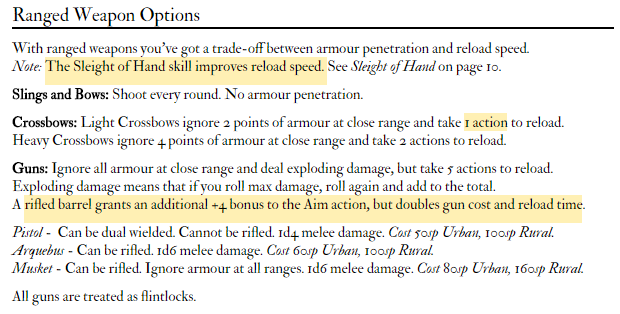
Ranged Weapon Options

- Firearms are all counted as flintlocks now.
- Rifled barrel improves Aim, instead of making up for range penalties
- Firearms ignore all armour at close range (all ranges for musket)


In a game where all of the various weapons have been cut down to several damage categories, it's a wonder I stuck with the Matchlock/Wheellock/Flintlock thing for so long. Who cares?
Everything is now counted as a flintlock, and if you want to have a rad wheellock on your pistol I'm not going to penalise you for it.

Range penalties literally never come up. I'm not going to measure ranges, and most if not all combat in this game is at short enough range that you don't need to worry about it.
Getting a rifled barrel means you double the Aim bonus to a big +8, at the expense of doubled reload time on a firearm you'd never manage to use more than once a fight anyway.
Finally, a reason to buy an Arquebus over a Pistol.
This should be an improvement even if you do measure ranges, since the Aim bonus makes up for the range penalties. Get your snipe on.
I was also doing the by-the-book firearms thing where guns pierce 5 points of AC, but piercing all armour is easier to adjudicate even if it's not entirely realistic.


Death and Dismemberment

- Updated for the modern era. 


This is all in pamphlet form now. Go see that post for an explanation of my game's most fiddly subsystem.
The main thing is to call them "Death Tokens" instead of "Death Dice", and add a bit more clarity. I think it's fine now.
This is a big wodge of complexity in the middle of an otherwise fairly rules light game, but it leads to a lot of fun gameplay for me. I swear.


---


Wear and Tear

- Removed weapon/armour Quality
- Removed sacrificing armour to reduce damage
- Added England Upturn'd misfire table for Notched firearms
- Dwarfs can completely fix a single item per day, up from one Notch per day.


Having different weapon Qualities which gave different chances of taking Notches was a good idea in theory but definitely very easy to forget about in the heat of battle.
You know what's not easy to forget in the heat of battle? Crits and fumbles! Any time a natural 1 or 20 comes up, people notice. So now weapon/armour damage is triggered by those exclusively.

Part of the impetus was having high quality weapons and armour to replace magic weapons and armour, but that was a nice idea that never worked out great. Just make it extra fancy or something. Hell, make it unbreakable. That's as good as magic.

There was a rule here last time where you could sacrifice armour to reduce an attack's damage to 1, but that's gone now. I kept forgetting and so did the players.

England Upturn'd has cool a firearm-exclusive misfire table that it wold be a shame not to use, so I'm using it.

Dwarf repairs are better now, just because it makes it easier. Give a Dwarf a day and he can fix an item. Solid. A Mending spell always fixed an item completely, but I'm calling it out here to make it clear.


Skills

- Called out skill-boosting equipment and skills that get boosted by Intelligence
- Backstab is a reworked Sneak Attack
- First Aid reworked - forces patient to Tempt Fate on a 6 instead of dealing damage, no longer heals HP
- Added Rapid Reload to Sleight of Hand
- Added Evade to Stealth
- Added Invention to Tinkering


A few changes around here.
Intelligence modifies Arcana and Languages. Nothing new there.
Specialist's Tools give a +1 to Tinkering and First Aid, that's not been in these rules before.
Same with Crampons granting a +1 to Climbing, which needs calling out really.

Backstab is a big change. See Fancy Combat Options above. Upgrade hits against surprised or flanked enemies to crits.

First Aid is now focused directly on field medicine, healing up a person who's reached 0HP and is dying from Death Tokens. The combat medic skill to bring the dying back from the brink!
Failing on a 6 used to deal 1 damage to the patient, but now it makes the patient Tempt Fate which fits the Death Token angle better.
Healing HP with First Aid has been scrapped, eating to heal works better and more reliably.

Rapid Reload skill was sort of in the rules before, but it's here now.
Roll Sleight of Hand to get a free Reload action. This means you can Reload twice in one round, or even Reload while fighting. Potentially fire a gun every 3 rounds if you've got good Sleight of Hand and focus on reloading, which almost makes it worth it.

Evade, again, see Fancy Combat Options above. Dodge and weave to gain an advantage against an enemy.

Invention has been in the game for a while, because players looove coming up with bullshit mechanical things like breathing apparatus or complicated traps.
Only change is that if a device works successfully it gets a +1 to Invention rolls in future, so you slowly build it up until it works consistently. Previously this had it working after three successful uses, but I think this is mechanically neater.

---

Rune Magic

- Minor tweaks


Due to mystery campaign reasons (and mild balance woes) the Repel rune doesn't generate stuff any more, only pushes it away. Breath weapons are too easy I guess!
There are a few other bits, but that's the main one.


Classes

- Added everything for each class, not just the things that are tweaked from baseline LotFP. You can run a class out of this document now.


Just makes it easier for people who aren't running LotFP to figure out everything a class has.

Onto actual changes that matter.


The Fighter

- Added Weapon Mastery


Fighters are simple. This is mostly on purpose, it's a straightforward class with a straightforward focus on straightforward murder.
People who want to be a fighter type tend to roll Barbarian nowadays. But I have a condition where any time we haven't had a Fighter in a while, I want to make Fighters better.

So here we are. Weapon Mastery. As seen in the Melee Weapon Types section, different kinds of weapons get different kinds of bonuses.
Fighters get those and more, with the bonuses intended to synergise with the base perks.
Having a Fighter that carries one of each weapon around sounds great.

The Choppy upgrade is suspiciously similar to 5e's great weapon thing, from which I took it.
The Smashy upgrade replaces the old "shiver armour on evens" thing. Hammer attack to make the enemy easier for your allies to hit. Combo with the new Backstab to good effect.
The Stabby upgrade means swords are very much the defensive weapon - use an action to Parry and hopefully you'll trigger one or more counterattacks. Amazing for a fully armoured and shielded Fighter.
The Shanky upgrade makes Fighters even more brutal wrestlers, seeing as their attack bonus means they'll win wrestles a lot.
The Whippy upgrade is to do some Indiana Jones shit and trip people up.


The Magic-User

- Altered Spell Interruption to make Chaos Mages more possible
- Made Spell Swap more lenient


Spell Interruption used to mean you could prevent a Spell Collapse with a Save vs Chaos.
Now a Save vs Chaos means you get to see what the Spell Collapse will do first, then choose whether you negate it. A small but significant change.
Shout out again to Aura Twilight's chaos magic table which I can't link enough.

Spell Swap now only has a penalty if you're swapping a higher level spell to a lower one, due to the potential magical leakage. You're forcing a larger amount of energy into a less complex spell and the magic might start leaking in around the sides.
Previously you had a penalty equal to the sum of the spell levels, so this is more lenient.
I want it to be slightly risky to swap a spell, but not so risky that I hear people going "nonono!" to a spell swap like the wizard's about to cast a Summon spell.

These Spell Swap rules carry over to other casters.


---


The Extras

- Added this class


My Extras class is so similar to Manola's original Extras class that it's not worth a class blog post.
The only minor difference is that the "Magic for the Masses" rule applies to all items.
If you've got less than 10 of an item, it can be used once per scene and each takes up a separate Encumbrance slot.
If you've got 10 of an item, it can be used every round and all 10 items take up a single Encumbrance slot.

Two bows means you can fire arrows twice per scene.
Ten bows means you can fire arrows every round.

Two suits of chain armour means you can get Chain AC twice a scene.
Ten suits of chain armour means you have Chain AC at all times.

It's very strange and meta, but that's the Extras in a nutshell!


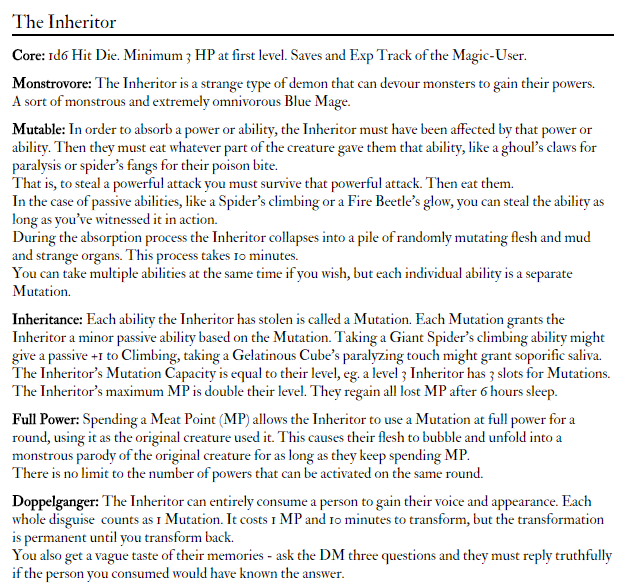
The Inheritor

- Added this class


Recently detailed in the Inheritor class post.
Eat monsters to steal their abilities and use them against your foes.
Enough of a niche that it doesn't step on other class's toes, and the game's first Inheritor so far has ended up being really interesting!


So that's that. A whole lot of incremental changes that I hopefully won't have a need to fiddle with for a while. Enjoy!