Showing posts with label play. Show all posts

Friday, 28 February 2025

Another Underclock

I've been using Arnold's Underclock since about 5 minutes after that blog post dropped. It's great!

Trouble is I do miss the "oh shit there's something here RIGHT NOW that we have to deal with!" aspect of random encounters. So, as is my way, I've decided to nest other peoples' ideas into one thing and pretend like it's a new thing.


This is my Underclock. There are many like it but this one is mine.


Fusion: Underclock AND Overload

I mean Arnold did say "I like overloaded encounter dice. I like the Underclock more".


In summary:
  • The players roll a 1d6 Encounter Die each exploration turn and mark off that many squares on the Underclock (left to right).
  • The Encounter Die is overloaded so it always does something, but it's usually some sort of Clue.
  • If they land on a monster face it's a classic Random Encounter. The clock keeps ticking.
  • If they reach the end they have an Encounter with the local faction. Reset the clock.
Simple enough right? 1 in 6 chance of a Random Encounter every time, plus it eventually builds up to a guaranteed encounter they can prepare for.


Alertness

But what is "Alertness", I hear you ask?
This represents the organised dungeon denizens seeking you out.

The DM rolls the Alertness Die if you did something to attract attention.
Cause a ruckus, let foes escape alive, blow up a door, set off an alarm, knock a skeleton down a big well even though a wizard told you not to, that sort of thing.

The Alertness Die result marks off squares back up the Underclock towards you, reducing the time horizon until you get that guaranteed encounter.

If this overtakes your position on the Underclock, they get the jump on you with a surprise round!


The Alertness Die starts at d2 and increases a die size per encumbrance tier. 
The highest encumbrance in the party counts, because stealthily slipping through shadows doesn't matter when Sir Stabbington is stomping close behind in heavy armour and carrying a sackful of jingling treasure.

There's also the fact that sleeping in a monster-infested cave is generally a bad move, but sometimes you've got no other choice.
The Alertness Die permanently increases by one step if you sleep (in modern parlance, take a Long Rest) in a dungeon.
This resets if you leave the dungeon and spend a night on the surface.

The DM can always bump it up a level or two if you're habitually going around making extra noise. Dragging a handcart full of loot around, escorting a gaggle of kids who think it's a museum trip, wielding a singing sword who won't shut up, etc.

Local Faction

As for what the "local faction" is, this is whatever organised foes are mostly likely to be around.

This will be the Goblins in the Goblin Lair, the Necromancers in the Skeletal Hoard, the Magnet Eaters in the Technodungeon, etc etc.
In a Megadungeon you might have different local factions across a dungeon level, like Goblins in the west and Ratmen in the east.
If there is no such group, like it's an abandoned wizard's tower or forgotten tomb, this is the Mythic Underworld itself trying to eject you by means of whatever the most defining beastie is inside it. In the Antediluvian Manse it's Cataclysm Ghosts. In the Cretan Labyrinth, it's the Minotaur.

The main thing is that the players should be able to make an educated guess at what's coming for them so if the Underclock is close to running out they can make plans for ambushes, fortifications, hiding places, or fun rooms to lure their enemies into. 

Of course if the PCs are on good terms with said local faction, this could be a perfectly charming little social encounter! Yet another good reason not to murder everyone you meet.


Mêlée à Trois

There is every possibility that the players can land on a square that has a monster face and has already been marked off by the local faction.

In this case there's a random encounter and a faction encounter simultaneously.
Get chaotic! Even the random encounter is Goblins and the faction is Goblins, make up a reason why these Goblins hate each other nearly as much as they hate intruders!


Overloaded Encounter Die

Finally, the Encounter Die itself.
The players always roll a d6 and it goes like so:
  1. Clue: Spoor
  2. Clue: Tracks
  3. Clue: Traces
  4. Noise
  5. Special
  6. Special

Clue

These are all ways of giving the players an idea of what sort of beasties live around here, as in the original overloaded "Percept (clue, spoor)" result or Shadowed encounters on the OG Underclock.

Clue: Spoor means the creature is very close. It could be stalking you. This will be growls, shadows rushing past at the corner of your eye, still-steaming shadow effluent.
Roll a random encounter, describe the spoor, and lock it in. Next time they hit a Random Encounter it will be with that creature. Lasts until they hit the random encounter or roll a different Clue.

Clue: Tracks means the creature isn't close, but it's been here recently. This will be footprints, slime trails, clawmarks, dropped scraps, a recently devoured corpse.
Roll a random encounter, describe the tracks (and decide where it is, within a few rooms). If the players follow the tracks they can find the creature and surprise it! If they ignore the tracks, no further effect.

Clue: Traces is just evidence of the creature being around here somewhere. This will be shed fur, graffiti, a molted exoskeleton, an old nest.
Roll the encounter die and describe the traces. No further effect.


Noise

An errant sneeze, an accidental clang of the shield against a wall, an unseen femur cracked beneath your tread. Whatever it is, you've made enough noise to attract attention.

Everyone checks their current Encumbrance (in case someone has been mysteriously lax), then the DM rolls the Alertness Die.


Special

These are dungeon-specific results to give a pinch of dungeon-specific flavour.

By default (ie. common dungeon and/or if I haven't prepared something in time) these are:
5. Doors: Open doors swing closed, and closed doors become stuck this turn.
6. Lights: Light sources flicker and dim, you can barely see this turn.

In a spoopy dungeon they could be:
5. Fear! Save or drop everything and run screaming back the way you came - Save again in each room, you stop running when you finally succeed.
6. Bats! Swarm of bats puts out all light sources, those without a light Save or take 1d6 damage.

In a crashed spaceship they could be:
5. Magnetic Pulse! All metal objects (including you, if you're in metal armour) are stuck to the ground this turn.
6. Null Gravity! Everyone's floating in zero-G this turn.

Add a couple of fun effects and the dungeon will hopefully be memorable! Especially if you are...


A Victim of a Series of Accidents

If I roll a Special result that triggers an encounter, do both happen?
Can I land on a random encounter and roll a clue simultaneously?
If the Encounter Die hits a random encounter AND a Noise result, resulting in the local faction surprising me, am I fucked?

Yes.
Very very much yes.

It's up to the DM to work out this particular admixture. The more chaotic the better!


Discussion, However Brief

So basically this sub-system retains the time pressure "oh shit let's plan ahead"-ness of the Underclock with the surprising "oh shit ITS HERE!"-ness of the random encounter roll.

When the Underclock is getting close to finishing, it's probably a good idea to be extra super quiet (so they don't get the drop on you) and prepare for whatever's going to turn up (by setting up your ambush and waiting out the last few dots on the Underclock).
This won't always work of course, there's always the risk of a Noise result giving the baddies an ambush opportunity, but most of the time it's reliable...

The intelligent monsters being a guaranteed eventuality and the wandering monsters being an occasional occurrence should give each dungeon its own special flavour and its own sense-memory for my poor benighted players. After all, what's the point of invading the Goblin Caves if you never actually see a Goblin?

Most importantly the systems interlock in a way that will surprise me too!


Plus I get to update my Marching Order sheet to make the Underclock a bigger deal.

I even updated the Fleeing Table! Find it here.


Friday, 25 November 2016

Party Upgrades in a Deadly Campaign

Update: For an audio version of this article, go to Blogs on Tape!


I run a game where character death happens.
This has a bunch of good effects on gameplay, but that's not the point of this post.

What I've been noticing is that the power of the party as a whole is constantly increasing, even as the individual characters die and are replaced with fresh first level folks.

There are three main avenues for this
- Party Stuff
- Party Influence
- Player Knowledge


My players have been banging out some FANTASTIC art for a good while now.
Credit: Tom of Dungeons & Doritos

Party Stuff

Magic items are the most obvious example.
The party stumbles across a magic item of some sort, whoever wants and/or needs it most claims it, and when they die it gets passed on to somebody else or their successor.

Possibly a TPK would break this chain, but in half a decade of running D&D I've still never presided over a TPK!
This campaign's been going for two and a half years now and STILL no TPKs. Maybe I am too nice, or maybe they are too clever to keep fighting when their friend's head gets eaten off. Who can say?
Edit - it happened

Also in this category - cash. I well remember the struggle to save up for plate armour in the early game. It still happens to players because Carousing and such keeps taking their money, but nowadays the armour question is less "can I afford this?" and more "how much can I carry?" which is slightly more interesting.

Due to carousing, cash also acts as one of several Save Point-ish mechanics.
If you die you can burn all your previous character's cash on buying back their exp and/or burn it on Carousing and its ilk.
If the party's cashed up, they can potentially pool money to bring a new character to party parity, which keeps the whole group powerful.


Party Influence

This is stuff that's only possible because the party has influenced the campaign world in some way.
The point is that the party has gained contacts and reputation as they go through places.
If they head back to Fortress City Fate, they've got their friend Slim Jimmy there who'll fence their goods. If they head to the mountains, they've got a bunch of gypsies who they rescued travelling around the area who can tell them what's going on.
This even happens in dungeons. If the group has previously helped/intimidated/befriended a faction of dungeon dwellers, that attitude is passed onto the group as a whole.
This also, in my campaign, includes investments. While these are mostly businesses that persist for the player (ie. persist across characters), they're also a great way for the party to gain as a whole.
A contact for one person is a contact for all people.


Player Knowledge

This is the Big One, but also the least obvious.
It's about each individual player's experience with the game, and how that adds to the whole.
Player Knowledge is fascinating to watch in play.
The Party-as-Unit enter an unfamiliar place and, by chance, one of the oldest running players remembers this. Sure, it was a previous character. Sure, it was a long time ago in real time. Sure, they don't remember the details. But the memory persists. And that memory belongs to the Party.

I love it.

The Party as an aggregate becomes stronger than each individual character, but importantly it becomes stronger than each individual player.
Knowledge is passed on from one player to another, and even when that player leaves their knowledge remains.
I get a fair amount of player churn here in London. People are forced to leave due to work or deportation or simply because the group's grown uncomfortably big and they feel forced out. Each generation of players becomes better than the last because there's a sort of fast-motion intergenerational knowledge transfer going on. New people take on that knowledge because it literally makes their character survive longer.

This includes both rules knowledge and in-fiction knowledge, and the intersection between the two becomes one of those interesting intersections between the player and their character.
"The kobolds set up lots of traps" and "The kobolds only have 1HD" are both useful bits of player knowledge that help you survive.
"Poison is bullshit overpowered". "Axes are good against unarmoured". "Goblins are vegetables". "Lulu's got a honey business up north". Is it out-of-character or in-character knowledge? Mostly both.
Everything adds to the ability of the party as an aggregate.

This is also why I'm unconcerned about metagaming (look at how angry this dude gets).
Any advantage based on player knowledge is a fair advantage, and on the outside "fuck, a ghoul! Scary looking!" and "fuck, a ghoul! Three attacks per round and paralyzing touch!" result in very similar actions.
I don't like separation between player and character, I like it to be a big soupy pool of not being entirely sure where the player and and the character begins.

There's a weird edge case here with my Rune Magic thing. I specifically invented it to be a Player Knowledge gimmick, and so we usually get a single person per player "generation" who takes it upon themselves to be the Rune Guy.
What's beautiful about this is that we've had a few Rune Guys in the span of the campaign, and they've always been the go-to guy for inscribing runes on shields and weapons and stuff.

And one day, life gets in the way. And they can't play for a while. And the crafted rune objects remain, but the knowledge of how to create them gets lost.
Which means the players have Party Stuff without the Player Knowledge to make more of them and it's fucking awesome. Especially when they tell new players there used to be this guy who could create fire with his fists and suck the air from your lungs and all sorts of crazy shit, and look, here's this infinite light source he left us with,

Now the current crop of players have tuned into this and began strategies to mitigate the loss of knowledge.
There's more than one Rune Guy now, and they've created little spell booklet things to ensure the knowledge gets passed on even if they're not at the session. It's neato.

Wednesday, 20 August 2014

So you’re running Better Than Any Man.

There’s not much point reviewing Better Than Any Man. The best thing at Free RPG Day 2013, one of the best products LotFP’s ever put out, chock full of stuff, yada yada.
It’s free and good for 10 or more sessions of adventuring. That’s some damn good bang for buck.

And it's the best intro to LotFP out there.

I’d run sandboxes before, but nothing this dense. BTAM is now my model for my world map at the local scale. It’s actually pretty small compared to my big six mile hexes but it’s absolutely filled with stuff to do, and at it never feels small. Everything is close enough to the hub city for a day trip which is actually a really nice way to do it.
Alright, so you’ve got your hands on Better Than Any Man. You’ve got your hands on the free pdf of the long-windedly named Lamentations of the Flame Princess: Weird Fantasy Roleplaying. You’re all set.

Here are some things that you need to know that aren’t explicit:

Monster HD = Attack Bonus. This rule is, bafflingly, only found in the referee book despite the referee book being unavailable and the rule being entirely crucial to gameplay. The referee book is not free and at time of writing is not even available since Raggi’s publishing a new one soon-ish.
Similarly, this is one of the reasons why some monsters have “2 Hit Dice (but with hit points of an 8 hit dice creature)” and similar which is confusing otherwise. It’s got 8HD-worth of hit points, but only attacks at a +2. The other reason is that they count as 2HD for things like Sleep spells which use hit dice to determine spell impact.
Also, if you were using Labyrinth Lord this is the HD you’d use on the attack matrix.
Encumbrance is simple but brutal. I was (and still am, truthfully) running off of the assumption that everything non-weaponry with the same name just goes into the same slot. Torch x3 or whatever.
Turns out that everything non-italicised in the equipment list, from rations to torches, each take up a separate slot. Harsh! They can likely obtain some porters somehow though, if only by promise of a better life and a share in the loot.
Considering the time limit on staying in the region, healing rates as written are very (or maybe, “realistically”) low. Chances are the characters won’t be able to rest up enough to get to maximum HP if they’re planning on getting anything done, especially if they have no Cleric support. I have house rules to bridge the gap (a First Aid skill and eating a ration healing d6 HP 1/day), but if you’re set on running LotFP as written keep this in mind.
Only a few hexes across but man, so packed.
Here’s a grab bag of things I added or changed:
Waking up in a dungeon is the best way to begin any adventure. Some shithead said that.
Rather than just wandering in from a map edge, the players wake up in the torture chamber under Goblin Hill. They are locals from the village of Thüngen who had been captured recently by the Bürgerfriedensmiliz. There is a single guard in the room distracted by the smells wafting from the kitchen. Their starting equipment is in the smaller cage in the room, and one of them has loose manacles. If there’s a demihuman in the party it’s them because the manacles don’t fit their wrists properly.
This isn’t meant to be a challenge to get out of, it’s just an initial setup, but waking up in chains means that the players have time to ask questions.  and build up an idea of what the room looks like and discuss their plans when the guard leaves the room briefly to grab some eyeball broth or whatever. It also means that they have a concrete reason to join up and stick together.


I expanded the random encounters into a larger encounter grid as seen here.
When people enter a village (“Entering a village should probably trigger an automatic encounter”) subtract 3 from the d6 roll, so they’ll find either spoor, a lair, or more commonly the thing itself.


As described in that post, I fantasy-ised the general early modern feel.
The Swedish became an army of demons.
Jews became Halflings.
Muslims became Dwarves.


The Watcher’s Detect Weapons spell only picks up objects that have been used in anger. Chiefly because the players had already been rejected from Karlstadt once and I wanted to let them in, but also because it neatly solves issues involving whether something counts as a weapon or not.
The Defiler’s creature as written sucks a person into their own personal sub-reality and fights their own creature tree. Fuck that, everyone goes down to the same layer. It was a heap of fun with people diving down the creature’s throat to save their friend and bring them back up a level. Make sure you make a foghorn-like BRAAAAAAAMMM sound every time someone goes deeper. The “real” creature fumbled and ate the Defiler herself at one point which was excellent, and to add insult to injury she’d just informed them that anyone who’s inside when it’s killed is lost forever.
Another thing about the Defiler’s creature – anything pushed into the creature’s second mouth (the one that recites the Canterbury tales) makes the object appear in the next sub-reality down but huge. They were nearly crushed by the Defiler’s spellbook at one point.
Beating the Joy at sex (or completing most of her increasingly seedy “missions”) means making an opposed roll, roll highest while staying below your stat as per house rules. You can use any stat you want so long as you can describe what you’re doing to make it relevant. Hee hee.
Up in Hammelburg there is a man who will pay good money (500sp) for help getting a pallet of his best wine out of the country. Payable once he's sold off his goods, of course. This is mainly because I wanted them to move off East to my main campaign map and the river goes there (heh heh heh). Incidentally, there’s a boat on the river and it’s not his…
Willibald Schwartz and Thungen’s “vampire” problem, which I expanded upon and might post some other time (basic gist at the end of this post), were relocated to Werneck. The players had never approached Willibald’s Mound and never encountered the glass tiger or even heard of the guy, so it felt legit to shift him around. Nothing’s canon until the players encounter it after all.
He made a great red herring. Crazy old wizard guy with a glass tiger meant that the player’s dominant vampire theory (until they found out the real culprit) was that the glass tiger was going and murdering people without Willibald’s knowledge.
Gunther Mohl the bandit chief in the Abandoned Farmhouse wore chainmail and had a big ol’ greatsword and 14 strength. He scared the shit out of the players, especially since I’ve got a house rule where great weapons add strength bonus to damage. The bandits also used the farmhouse-barn route to flank and disappear and just be generally tricksy in combat.


Some highlights from when I ran it:
Initial party of two (a dwarf and a necromancer) escaped easily from Goblin Hill. The necromancer had never played before. After the dwarf slipped his manacles and knocked out the guard, the necromancer showed good old school thinking and stole the guard’s cultist robes. She snuck the Dwarf out under the pretence she was moving the prisoner and they escaped.
That very same session, the Dwarf had his kidney forcibly removed by a giant rhinoceros beetle.
The Joy’s brothel/tavern became the de facto home of the adventurers. One of their number spent every night with the Joy and impressed her to such an extent that she later joined the party as a henchman.
The chief bandit in the Abandoned Farmhouse was judged “way OP” in his chain and greatsword. They eventually got him by wrapping a glue-soaked carpet around him then setting him alight, before diving into the cellar to escape the flames. Old Man Braasch the zombie horror was a nice surprise just when they thought they were safe. Purging things with fire, predictably, became something of a theme.
Attempting to cut off a lock of the Defiler’s hair as per one of the Joy’s challenges led to a long and mindbending fight through multiple internal realities at the hands (or rather, mouths) of the Defiler’s creature. The Defiler herself getting swallowed by one of the Creature’s fumbles was the icing on the cake.
On a related but unrelated-to-BTAM note, this was also the inaugural session of my new crit and fumble tables and they worked magnificently. A barbarian had shown up for this session only, and he managed to chain a fumble into a crit against himself and keep going about 5 times. He would have disembowled himself had I not gone soft and let him get tied up in his own no-damage mancatcher instead.
A raid on Goblin Hill to kill the Mother led to a variety of horror. The people in the kitchen had Sleep cast upon them, and following several minutes of furious debate over the morality of killing children even though they are cannibals, our heroes chopped the heads off of all the kids, branded them, and lined them up as a “warning”. In order to keep the other cultists occupied, the chefs were “spatchcocked” and artfully sewn together in a horrific meaty confection and carried out into the dining room to applause.
In that same raid they captured a war-ant (some of whose legs were later stolen by the Mother’s creature) and the Mother herself was instakilled by a critical Sneak Attack which dealt a full 24 damage.
The ensuing escape from her enraged Creature in the next session ended up giving people multiple new limbs. Later, when the wizard had finally managed to get his new knee-arm under control, he used it to dual-wield both a bow and a flail.
Finally, in the twelfth session of BTAM-based gameplay, they successfully sailed a river barge full of wine off the map. Two characters, after surviving everything BTAM had to throw at them, died upon contact with A Single Small Cut. God rest their souls.

 Rating: 11 1/2 sessions of gameplay.

Friday, 13 June 2014

So I Ran A Single, Small Cut - A Review with an Anecdote


Some choice quotes from my players:

“Don’t take weapons into the church? Fuck that I’m waiting outside. You talk to the priest.”
“If the priest was evil why would he point out the bandits for me? Oh shit he’s behind me isn’t he.”
“I’m going to wrestle him into the altar door thing… ok I uh.. I rolled a 1.”
“I run in and wave my arms around like in Men in Black when they’re trying to distract a monster and yell at Kacey to get out of here.”
“You’re dead?! No way am I running, my character wouldn’t go on living without you. I’ve got.. like.. 9 flasks of oil, 3 jars of that black stuff that we think is explosive, and I never washed my clothes after I fell into it. What do I roll if I blow myself up?”
“I walk past the people outside and tell them – it is done.”

A Single, Small Butt.

First deaths of the England campaign! And they were way more dramatic and far less shitty and futile than I would have predicted for a campaign based on LotFP!

What did I change?
To make it a bit fairer for lower level players (no fun if they get murdered by humans before the monster shows up) -
The fighters with crossbows up top were just regular unclassed dudes with crossbows.
The Corrector of Sins had the hit points of an 8HD creature while keeping the +12 to hit (not that it mattered in the end..)

Did I like it?
I need to make some stuff like this, having a pocketful of One Page Dungeons is fine but having a few slottable set piece encounters around is tops too.
Simple little mostly-just-an-encounter with a nice map of a church (reusable!) and some cool stuff the players didn’t get to yet, mostly due to the aforementioned deaths.
Corrector of Sins is badass but escapable and looks like it will be fun if/when the players claim the red bell that summons it.
I liked how it specified the priest talked in a nasal voice because I don’t do that voice often and I had a cold so it went well. More modules should specify NPC voices.
Some of the info could be summarised or highlighted a bit better, mainly because I was running this off the cuff, but it’s certainly short enough to skim over while your players are trying to work out what to do.
They haven't actually gone back to check out the crypt part yet with the potential second Corrector so that should be funky, even though the dead bodies above are mostly ash.
All in all, good for slotting into your campaign whenever people are going somewhere and you need an hour or so of material!

What happened when I ran it?

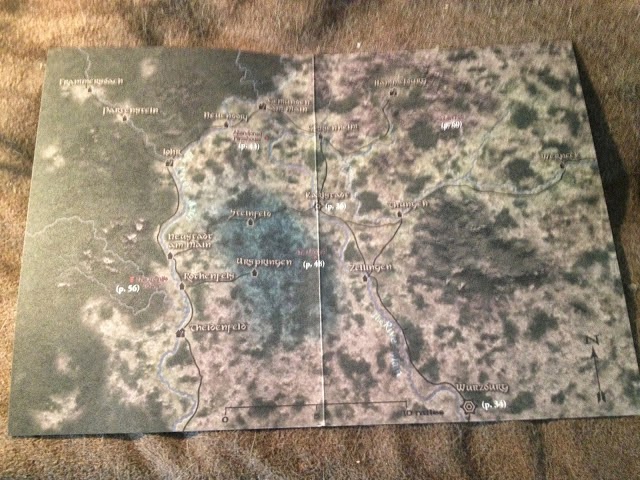
Rather than initiate time travel shenanigans as I'd anticipated, a low player count and lack of wizards meant that last night's party decided to do other things, namely travel out of BTAM's play area and into my new one, seen above.
With a large pallet of wine to sell off, the party see a church from their stolen boat and decide that it’ll be the perfect place to liquidate their assets.

They are a Thief (Specialist 3) and an Assassin (Specialist 2), who have made a name for themselves as the Redeemers, along with a Mercenary (Fighter 1) who they have never actually met before but seemed cool with getting paid for this.
While the Thief goes to check out the wattle-and-daub village, the Mercenary and the Assassin approach the church doors.
Within, the priest’s unpriestly aspect goes unremarked but the admonition to disarm in a house of the Gods draws immediate suspicion. The Fighter bugs out and prowls around the outside of the church to see if there’s anything suspicious because putting down his spear for half a minute is out of the question.

The Assassin follows the priest in and an ambush occurs! It is assassin vs assassin, garrotte vs hidden garrotte as the priest reveals his true colours close to a smashed-in door below the altar! The Mercenary, drawn by the noise, sprints in and is instantly peppered by crossbow bolts from above! He reels back and ascends the stairs to the upper level with vengeance in his eyes.
Two scared-shitless guys sprint up the stairs beneath the altar, so the Assassin attempts to kick the false priest down it to forestall whatever’s chasing them. He fails badly and get half-strangled for his trouble, but at least the priest is closest to the altar door now.

The Thief has been drawn by the sounds of battle and enters just in time to see a horrible meat monster ascend, devastate the false priest with flailing intestines, and significantly wound the Assassin.
As the Mercenary cleaves through two enemies above and causes the rest to flee, the Thief runs in and starts waving his hands around “like in Men in Black when he’s distracting the monster”. I distribute the creature’s attacks randomly – all on the Thief. It looks like it worked.

The Thief beseeches the Assassin to flee as the creature violates him to death under a torrent of toothed intestintacles, but the Assassin will not run.
He realises that the Redeemers have been through too much together, that he can’t go on living on his own. He realises that if the creature gets into the town it will kill everyone around, and that up until now they’ve ruined people’s lives no matter how good their intentions were.
Plus that witch made them fuck each other that one time and he’s been harbouring confused feelings ever since.

The Assassin sees the Mercenary backing out of the door. Smiles.
He takes stock of his inventory – 9 flasks of oil. 3 jars of sticky black super-oil from the wizard’s cave. 1 set of unwashed clothes covered in the same sticky super-oil.
He takes a candle.


“All this time we’ve been trying to redeem other people", he says, "now it’s time to redeem ourselves.”

Rating:


2/3 dead PCs