Showing posts with label specialist. Show all posts

Sunday, 6 October 2024

Speech Impediments - For When PCs Remember a Language They've Never Spoken

We've all been there.

The party is confronted with an otherworldly horror uttering guttural chants, or behold a mysterious elven monolith covered in curling runes that twist before their eyes, or stand enraptured before the song of an ancient angel from a forgotten heaven, or receive an email from the marketing department.

Then one of your players hits you with the "oh wait that's one of my languages!" and you have to let them speak to whatever it is.

In regular D&D where you pick Languages during char gen, this happens when it turns out someone has been able to speak Gnomish or Celestial the whole time.

In my game this happens because my players insist on rolling Languages any time they come across a new creature that shows even the tiniest glimmer of sentience. This is why several characters apparently speak fluent Eastern Lowland Gorillese.
This is really very silly but it's fun enough to keep (a la the secret fourth option in this post).

What's the "solution" to this "problem"?
They obviously know the language, but given the fact that they've never even mentioned that they can speak it in months of adventuring it must have been quite a while since they did that exchange trip to the eighth circle of hell.
But they're totally fluent of course, but uhhh... how do you say...


I'm a Bit Rusty

The first time your character speaks a language that they haven't previously spoken in-game, they're rusty.

Roll 1d30:

RollResult
1Can only speak in single syllables
2Tourist phrasebook content only - "two beers please", "which way to museum?" etc.
3They understand you but are always offended.
4Words that start with a vowel only.
5One word sentences only.
6Absolutely always alliterate.
7Words that start with a plosive only
8Must "speak" by describing emojis.
9Swear words only.
10Must speak way too loudly.
11Can only speak in quotations and metaphor.
12Sentences must be spoken in reverse order
13"Snake Snanguage" - all words start with the first two sounds of that language.
14Unable to use pronouns (I/you/he/her/it/etc)
15Unable to speak in present tense
16No verbs
17Speak in Haiku
18Can only write it, not speak it.
19Only know numbers
20"G" and "J" must be pronounced with a soft "zh" sound, as in treasure or casual
21No nouns
22Last letter of one word must begin the next word.
23One must refer to oneself as one, and instead of "we" or "they" must state the number of people in the group (eg. "One was with Four when someone robbed Two house")
24No adjectives
25All phrases must be an innuendo, if you know what I mean
26All sentences must be noun-verb-object
27Must stand on one leg while speaking
28Overly formal, everyone must have a title, no contractions, etc etc
29Every noun must be described by an incongruous and/or false adjective.
30Can speak the language but only in a cartoonish over the top accent.

When you speak that language you must abide by the rolled limitation.
This represents your character pausing to think, forgetting words, getting tones wrong, using the wrong conjugations, and other such issues with dredging up the language you haven't used in a long time.
Failing to do so means you've said complete gobbledegook and nobody understands what you just said.

In subsequent sessions it's all come back to you and you are completely fluent.
Presumably you quickly brushed up on some refresher notes, or beseeched the Horrible Green Owl to reinstate your streak.

Specialists, of course, are always fluent from the get-go. Skills are their whole deal after all.


Sunday, 29 March 2020

Harder/Better/Faster/Stronger - A Crafting System

One of my players has been getting big into the idea of being some sort of Mad Scientist specialist, which naturally necessitates a bullshit crafting system!

Did I phrase everything like this to shoehorn a reference to a two decade old Daft Punk song into a crafting system?
... Perhaps.


The Central Gimmick

When you upgrade an object or device, you can choose to upgrade any one of these four essential aspects:
  • Harder:
    Make it sturdier, tougher, more resistant to harm.
    A bit like improving its Constitution.
  • Better:
    Make it multi-use, prettier, or otherwise upgrade it in a way oblique to its usual purpose.
    A bit like improving its Int/Cha/Wis.
  • Faster:
    Make it easier to use, faster to deploy, or quicker to recover.
    A bit like improving its Dexterity.
  • Stronger:
    Make it more powerful, more effective, better at its primary task.
    A bit like improving its Strength.

But nothing improves without sacrifice.
When you upgrade one aspect, you must downgrade another.

Roll Tinkering.
On success, you choose the downgrade.
On failure, the DM chooses.

The downgrades are the inverse of those above:
  • Brittle:
    It breaks easily, or gives less protection, or needs excessive care to maintain.
  • Worse:
    It's uglier, less useful, more obvious, or otherwise less good in a way oblique to its primary purpose.
  • Slow:
    It's unreliable, difficult to control, or requires laborious reloading.
  • Weak:
    It's less powerful, less effective, and not as good at doing the main thing it should be able to do.

Naturally the actual mechanical impact of these relatively vague categories is down to negotiation with the DM.


Intent

This is primarily designed to allow some fun inventions and equipment upgrades without getting into the world of +1 Swords and other straight upgrades. I like it when things have upsides and downsides - not necessarily for any balance reasons, just because it's nice to have interesting choices.

Plus Tinkering is a fun skill that's not used so much beyond repairing gear, and once you've opened the door to weird and wacky inventions why stop?
Plus if I'm leaning into this post-apoc thing, having scratch-built equipment that does funky stuff is very on-theme!

The aspects are quite loose and open to interpretation.
Harder, Faster and Stronger are supposed to be your fairly straightforward upgrades and downgrades.
Sword does more damage (Stronger) but breaks easily (Brittle).
Armour is more effective (Harder) but encumbers you more (Slow).
Firearm loads swiftly (Faster) but doesn't pierce armour (Weak).

The "fun" aka more ruling-heavy part is in the Better/Worse metric.
An easy one would be like classic ceremonial armour that's super classy and impressive (Better) but easily damaged (Brittle).
But how about adding a gun to a katar (Better) so you can shoot while you punch? Maybe the actual weapons are less effective (Weak) but who cares when you can punch bullets into people?
Build an oil channel and spark into a sword to make it go on fire (Better) but at the cost of having to reload it with special oil between times (Slow). Go wild!


Wednesday, 7 March 2018

House Rules Update! 2018 edition

Another year, another metamorphosis!


PDF here


The main impetus this time around is basically to trim off as much fat and fiddly bits as possible, especially in the combat rules. If there's something in the rules that never gets used or I always forget about, it's gone.
It's become increasingly obvious that the Gambit is the only combat option anyone really needs. It's simple, has an obvious risk-reward angle, and has the exciting partial success possibility.
I've trimmed off anything that's not covered by a Gambit and simplified the rest.

The other thing is that Sneak Attack has always been a sticking point in the game. It's a weird outlier in terms of how skills work and is useless without a high Stealth to back it up.
Probably the biggest change in this update is reworking Sneak Attack and Stealth so they're not so tightly linked. Sneak Attack has been reworked into Backstab which is primarily for ganging up on the same enemy, but also still effective for traditional shanks from the shadows.
I'll go into it more when I get to that section below.

On the less rules-tweak side of things, I've added a few more bits to make the rules a bit more standalone, like putting basics about HP and AC and stats in the doc. It's not exactly a Ten Foot Polemic standalone game (yet?), but it's in here so you don't have to cross-reference with the LotFP rulebook so much. This is important if you are, for instance, one of my own players trying to use my rules to run your own session.

I've pulled out the relevant sections of the rules for ease of use, but do feel free to follow along in the house rules document.
So here we go, a change log with explanations and stuff as we go.


Char Gen

- Removed Ammo Dice
- 
Ammunition isn't tracked unless something happens to make ammo tracking important.


I'll talk about this here - the death of the Ammo Die.
Oh wow the site I originally got it from seems to be dead! My house rules are old!
Archive copy of the ammo die post here.
Anyway, the idea behind the cascading Ammo Die made its way into the Black Hack as the Usage Die. Seemed like a great way to track arrows etc in the abstract, but man I can't remember the last time someone fired enough arrows for it to matter. When the bulk of the game is dungeons and firing into melee is dangerous, you just don't fire that many arrows.
I've left the door open for resource management if people are in the middle of a desert or something, but in the main we're not going to be tracking ammo any more.


The Basic Basics

- Added this whole section


 Just making things a bit more clear because there are some minor changes from LotFP.
Most notably, making it clear that HP is your luck-shield not your life points per se.
Also, Surprised AC in the LotFP rulebook is surprisingly hard to find, so that's here now.
Armour rules also gathered into one place, which means there's a teaser for the new sword rules in here too.

Stats

- Added this whole section


Explanation of stats because it's subtly different from LotFP, mostly by accident over time.
Clearly the lore/reasoning is more or less transposed directly from the LotFP rulebook.
Most importantly - something I never realised was that Int/Wis were supposed to influence the Saves of people targeted by Magic-User/Cleric spells! I've never done that, so it's gone. In its place is being a better caster via recovered from Interrupted Casting and Spell Swaps. Works for me.
Oh and did you know that Charisma doesn't affect Reaction Rolls by the LotFP rules? I sure didn't! So that's called out as affecting Reaction Rolls now.


Hazards

- Moved Falling here
- Added Fire rules for ease of reference
- Added Drowning


Original falling rules make falls very dangerous, and means anything that makes your fall count as 10' less could potentially save you from massive amounts of damage.
Fire rules in LotFP are nice. I like them, but added a few extra bits from rulings we've had in the past.
Drowning has claimed the life of several adventurers in my game, would you believe. The ruling at the time turned out to be surprisingly functional - 5 rounds of activity (+/- Con) before you start taking damage.


---

Rations

- Added temporary shelter ruling


All the same as before, except that it's possible to set up a makeshift shelter in the wilderness if you spend a day and roll Bushcraft.
Requiring a tent and rations to heal quickly in the wilderness works well, but what do you do if you forgot to buy a tent and/or your tent got destroyed by an angry bear?
You can build a semi-permanent shelter in the wilderness with a day and a successful Bushcraft roll.
Tents are a shortcut that you can pack up and move easily every day, so they're much better for travel than spending a day scratch-building a shelter every time someone needs to heal quickly.


Magical Healing

- Tweaks to Cleric spells that deal with poison


This has been in the poison rules post for a couple years now, but this is the first time I've stuck it in the house rules doc.
Delay Poison means you'll likely have processed the poison before it kills you.
Neutralise Poison... neutralises poison.


---


Basic Combat

- Added Magic to this section


This is in the Classes section too, but it really should have been here all along.
Declare casting at the start of the round, you need to be protected until it goes off at the end of the round. Standard in my game since forever.


Fancy Combat Options

- Removed Bumrush
- Removed gimmicky Parry rules, rolled Disengage into Parry
- Replaced Sneak Attack with Backstab
- Added Evade
- Clarified Wrestling
- Moved setting spears to Reach weapon section


Here we go! Some big changes.

Bumrush/Charge is easily a gambit. I'm surprised it lasted so long really.
Parry and Disengage were two similarly defensive but separate actions before. Now Parry is just the overall defensive "please don't hurt me" action, boosting AC and avoiding Opportunity Attacks.

The new Backstab will come up lots more. It's primarily a bonus for flanking enemies now, with a secondary use for killing surprised enemies. Flanking is a 5e-style thing, multiple people attacking one target in melee. Optimally you'll have a tank distracting the enemy while you come in with the Backstab. Conveniently this can be used to make pack-hunting enemies more dangerous by giving them good Backstab scores.

Evade appeared in this skills post as "Combat Stealth" but it's in the house rules now. Takes an action and a successful skill roll, so only useful if you have reliable Stealth.
Great for setting up a Backstab since it gives you +4 to hit and they can't target you on their next turn, guaranteeing Flanking.

Together, Aim, Evade and Parry form a sort of combat boost trifecta.
Aim is use an action, boost ranged attack.
Evade is use an action, boost melee attack.
Parry is use an action, boost AC.
Maybe the almighty Gambit will eat them all next time round, but I like the balance for now.

Wrestling is great. Adding some clarity for multiple wrestlers, and how wrestling rolls happen on both sides of the round.
+/- 1000 for natural 1s and 20s is for the silliness of it, but also neatly describes "a natural 20 automatically wins a wrestle, unless both people roll a natural 20 in which case it's still down to modifiers".

Spears in a bit.

Melee Weapon Types

- Choppy weapons changed: deal improved damage die against light armour or less
- Stabby weapons changed: +1 to melee AC and +1 to melee attack bonus


I still enjoy differentiating the weapons like this, even if it bumps up the complexity a little. With a general lack of magical weapons in a low magic game, weapon choice takes up some of the slack.
They used to trigger effects depending on whether you rolled evens or won initiative or whatever, but that's really too fiddly and complicated. It might maybe be fine if you're a player, but for poor old me rolling for a bunch of enemies at once that's too much overhead.

So now this should all be much easier for someone rolling a bunch of dice at once, and hopefully easier for the players.

Choppy axes deal improved die of damage against low armour targets. This means a greataxe vs a generic peasant rolls 1d12!
Smashy hammers are the same as before, piercing high armour targets.
Stabby swords are a straightforward upgrade against any target. +1 to hit, +1 to melee AC. Pair with a shield and you've got +2 AC against both melee and ranged attacks. Heavy armour, sword, and shield gives you a tip top 20 AC which is the effective maximum.
I might rename "Stabby" to "Versatile" to make it clear that they're good for offense and defence, but I'm keeping it for now.
Shanky is unchanged, deal bonus damage in a Wrestle if your roll beats their AC. Knife fights get messy.
Whippy is also unchanged. Ranged wrestle.

Noted here too: the Fighter gets extra bonuses on top of these. They're better than anyone else with any weapon, which is as it should be I think.


Melee Weapon Options

- Reach Weapons allow you to make an Opportunity Attack against enemies moving into melee.


Not actually a change, just not highlighted like this before. Was previously under the overcomplicated Parry action.
Opportunity Attack against approaching enemies makes the spear a superior defensive weapon, and good for defending your friends.

Also interacts with the new disengaging Parry. You can close in on a spear wielder by using Parry to avoid the Opportunity Attack, at the expense of not being able to attack them when you get in close enough.
Dropping Charge/Bumrush means that I can just drop setting spears against a charge. Spears are set against anything moving into range automatically, but no bonus to damage.


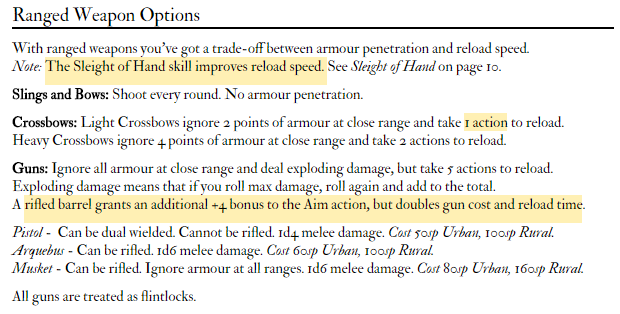
Ranged Weapon Options

- Firearms are all counted as flintlocks now.
- Rifled barrel improves Aim, instead of making up for range penalties
- Firearms ignore all armour at close range (all ranges for musket)


In a game where all of the various weapons have been cut down to several damage categories, it's a wonder I stuck with the Matchlock/Wheellock/Flintlock thing for so long. Who cares?
Everything is now counted as a flintlock, and if you want to have a rad wheellock on your pistol I'm not going to penalise you for it.

Range penalties literally never come up. I'm not going to measure ranges, and most if not all combat in this game is at short enough range that you don't need to worry about it.
Getting a rifled barrel means you double the Aim bonus to a big +8, at the expense of doubled reload time on a firearm you'd never manage to use more than once a fight anyway.
Finally, a reason to buy an Arquebus over a Pistol.
This should be an improvement even if you do measure ranges, since the Aim bonus makes up for the range penalties. Get your snipe on.
I was also doing the by-the-book firearms thing where guns pierce 5 points of AC, but piercing all armour is easier to adjudicate even if it's not entirely realistic.


Death and Dismemberment

- Updated for the modern era. 


This is all in pamphlet form now. Go see that post for an explanation of my game's most fiddly subsystem.
The main thing is to call them "Death Tokens" instead of "Death Dice", and add a bit more clarity. I think it's fine now.
This is a big wodge of complexity in the middle of an otherwise fairly rules light game, but it leads to a lot of fun gameplay for me. I swear.


---


Wear and Tear

- Removed weapon/armour Quality
- Removed sacrificing armour to reduce damage
- Added England Upturn'd misfire table for Notched firearms
- Dwarfs can completely fix a single item per day, up from one Notch per day.


Having different weapon Qualities which gave different chances of taking Notches was a good idea in theory but definitely very easy to forget about in the heat of battle.
You know what's not easy to forget in the heat of battle? Crits and fumbles! Any time a natural 1 or 20 comes up, people notice. So now weapon/armour damage is triggered by those exclusively.

Part of the impetus was having high quality weapons and armour to replace magic weapons and armour, but that was a nice idea that never worked out great. Just make it extra fancy or something. Hell, make it unbreakable. That's as good as magic.

There was a rule here last time where you could sacrifice armour to reduce an attack's damage to 1, but that's gone now. I kept forgetting and so did the players.

England Upturn'd has cool a firearm-exclusive misfire table that it wold be a shame not to use, so I'm using it.

Dwarf repairs are better now, just because it makes it easier. Give a Dwarf a day and he can fix an item. Solid. A Mending spell always fixed an item completely, but I'm calling it out here to make it clear.


Skills

- Called out skill-boosting equipment and skills that get boosted by Intelligence
- Backstab is a reworked Sneak Attack
- First Aid reworked - forces patient to Tempt Fate on a 6 instead of dealing damage, no longer heals HP
- Added Rapid Reload to Sleight of Hand
- Added Evade to Stealth
- Added Invention to Tinkering


A few changes around here.
Intelligence modifies Arcana and Languages. Nothing new there.
Specialist's Tools give a +1 to Tinkering and First Aid, that's not been in these rules before.
Same with Crampons granting a +1 to Climbing, which needs calling out really.

Backstab is a big change. See Fancy Combat Options above. Upgrade hits against surprised or flanked enemies to crits.

First Aid is now focused directly on field medicine, healing up a person who's reached 0HP and is dying from Death Tokens. The combat medic skill to bring the dying back from the brink!
Failing on a 6 used to deal 1 damage to the patient, but now it makes the patient Tempt Fate which fits the Death Token angle better.
Healing HP with First Aid has been scrapped, eating to heal works better and more reliably.

Rapid Reload skill was sort of in the rules before, but it's here now.
Roll Sleight of Hand to get a free Reload action. This means you can Reload twice in one round, or even Reload while fighting. Potentially fire a gun every 3 rounds if you've got good Sleight of Hand and focus on reloading, which almost makes it worth it.

Evade, again, see Fancy Combat Options above. Dodge and weave to gain an advantage against an enemy.

Invention has been in the game for a while, because players looove coming up with bullshit mechanical things like breathing apparatus or complicated traps.
Only change is that if a device works successfully it gets a +1 to Invention rolls in future, so you slowly build it up until it works consistently. Previously this had it working after three successful uses, but I think this is mechanically neater.

---

Rune Magic

- Minor tweaks


Due to mystery campaign reasons (and mild balance woes) the Repel rune doesn't generate stuff any more, only pushes it away. Breath weapons are too easy I guess!
There are a few other bits, but that's the main one.


Classes

- Added everything for each class, not just the things that are tweaked from baseline LotFP. You can run a class out of this document now.


Just makes it easier for people who aren't running LotFP to figure out everything a class has.

Onto actual changes that matter.


The Fighter

- Added Weapon Mastery


Fighters are simple. This is mostly on purpose, it's a straightforward class with a straightforward focus on straightforward murder.
People who want to be a fighter type tend to roll Barbarian nowadays. But I have a condition where any time we haven't had a Fighter in a while, I want to make Fighters better.

So here we are. Weapon Mastery. As seen in the Melee Weapon Types section, different kinds of weapons get different kinds of bonuses.
Fighters get those and more, with the bonuses intended to synergise with the base perks.
Having a Fighter that carries one of each weapon around sounds great.

The Choppy upgrade is suspiciously similar to 5e's great weapon thing, from which I took it.
The Smashy upgrade replaces the old "shiver armour on evens" thing. Hammer attack to make the enemy easier for your allies to hit. Combo with the new Backstab to good effect.
The Stabby upgrade means swords are very much the defensive weapon - use an action to Parry and hopefully you'll trigger one or more counterattacks. Amazing for a fully armoured and shielded Fighter.
The Shanky upgrade makes Fighters even more brutal wrestlers, seeing as their attack bonus means they'll win wrestles a lot.
The Whippy upgrade is to do some Indiana Jones shit and trip people up.


The Magic-User

- Altered Spell Interruption to make Chaos Mages more possible
- Made Spell Swap more lenient


Spell Interruption used to mean you could prevent a Spell Collapse with a Save vs Chaos.
Now a Save vs Chaos means you get to see what the Spell Collapse will do first, then choose whether you negate it. A small but significant change.
Shout out again to Aura Twilight's chaos magic table which I can't link enough.

Spell Swap now only has a penalty if you're swapping a higher level spell to a lower one, due to the potential magical leakage. You're forcing a larger amount of energy into a less complex spell and the magic might start leaking in around the sides.
Previously you had a penalty equal to the sum of the spell levels, so this is more lenient.
I want it to be slightly risky to swap a spell, but not so risky that I hear people going "nonono!" to a spell swap like the wizard's about to cast a Summon spell.

These Spell Swap rules carry over to other casters.


---


The Extras

- Added this class


My Extras class is so similar to Manola's original Extras class that it's not worth a class blog post.
The only minor difference is that the "Magic for the Masses" rule applies to all items.
If you've got less than 10 of an item, it can be used once per scene and each takes up a separate Encumbrance slot.
If you've got 10 of an item, it can be used every round and all 10 items take up a single Encumbrance slot.

Two bows means you can fire arrows twice per scene.
Ten bows means you can fire arrows every round.

Two suits of chain armour means you can get Chain AC twice a scene.
Ten suits of chain armour means you have Chain AC at all times.

It's very strange and meta, but that's the Extras in a nutshell!


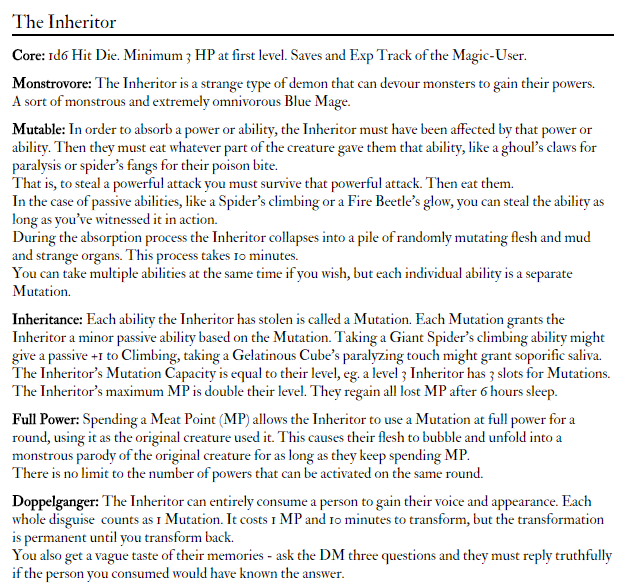
The Inheritor

- Added this class


Recently detailed in the Inheritor class post.
Eat monsters to steal their abilities and use them against your foes.
Enough of a niche that it doesn't step on other class's toes, and the game's first Inheritor so far has ended up being really interesting!


So that's that. A whole lot of incremental changes that I hopefully won't have a need to fiddle with for a while. Enjoy!

Sunday, 4 June 2017

Unified House Rule Document Update AND Handy Linked PDF

Mid-year update whaaaat.

Mostly this is because I'm always a little bit "oh no!" when I discover someone's been reading the house rule doc and it's NOT UP TO DATE OH NO.

Occasionally I get a comment that's like "hey could you put all the Lorebonds and elf powers and stuff into the one pdf?" so that it can basically be played out of the box.
The answer is - kinda!

You can now find a Linked PDF Version here. Intended to be used/perused digitally, everything you need an external resource should have a handy-dandy link.

You can find the non-Linked PDF Version here. Intended to be printed out for table use.


Linked Version

Unlinked Version


For context for some of these changes, at the beginning of the year we had the campaign's first ever TPK! So we skipped the timeframe forward half a century so people could see what's happened in the interrim.
How exciting!

Change Log:

Religion:

- Added Zeanism, based on the teachings of one of the player characters who took the Termaxian "do whatever you want, the gods aren't watching!" thing to heart.
Basically this is the drug religion now, and the Cleric spell allows you to take drugs with no downsides!
- Termaxianism has changed in the last 50 years, mostly because they're pretty sure that God lost the final war for all creation. Now it's up to them to finish the fight. No change besides their general lore.
- Nonanism is now accepting of the Undead and Necromancy in general. Pragmatism or corruption? Who can say? Another lore change, they're mechanically the same. 

Char Gen:

- Removed the Cartographer equipment pack because it contained paper and pens and I can't be fucked to enforce the need for paper in order to draw a map any more. It was a boring idea anyway.

Experience Points:

- Added Party Roles as directly inspired by John Bell at the Retired Adventurer. This has been real useful for keeping track of stuff and keeping players engaged even if they're not directly involved in the action.

Living Standards:

- Originally you needed to get to Comfortable conditions in order to heal from 0HP to 1HP, no longer! Otherwise it interacts weirdly with the "Take a Break" option where you eat a ration to heal 1d6 HP.
- Comfortable conditions now give you an extra 1d6 bump if you're already at full health! You'd imagine everyone would prefer comfy sleeps, but if you get nothing extra at max health you may as well save your money and live in a bin.
- Splendid conditions grant 1d6+level extra temp HP, since Comfortable conditions stole that thunder.

Big Purple d30 Rule

- Now upgrades a single die roll to the next die size when used. Previously you could replace any single roll with the Big Purple d30, which had the surprisingly underwhelming effect of making it an "I Win" button. This compounded by the large number of d30s players would accrue through buying me beer...

Downtime Activities

- Magical Research went through a few changes to make it slightly more interesting.

Fancy Combat Actions

- Changes to Sneak Attack. Now you roll when attacking from surprise to find your extra attack bonus, and enemies with high Awareness (renamed Search) have a chance of avoiding the damage multiplier.

Fancy Combat Reactions

- Split these off into their own heading.
- Parry covers all defensive melee actions. Smaller weapons can counter, larger weapons can disarm, and setting spears against charge is now covered under the Parry banner.

Melee Weapon Types

- One day I'll probably either remove these or make them Fighter-only, but for now I'm simplifying further. I've got lots of players and don't want things to stay as fiddly as they were.
- Axes remain the same - double damage on evens vs low armour.
- Hammers get +2 vs Chain or better. Straight up.
- Swords get +1 to hit across the board. Versatile, never a bad choice, a little boring.
- Knives give bonus damage if you beat their AC with your Wrestle Roll because you're shanking the shit out of them.
- Whips remain.

Ranged Weapon Options

- Flintlocks are in the game post-timeskip! Hurrah! That's basically it.

Death & Dismemberment

- Rewritten for the millionth time. This remains one of my favourite subsystems but boy is it hard to explain when you're not just passing out dice around a table.

Running Away

- Added a section on this very important aspect of not dying.

New Skills

- Search renamed to Awareness.
- Sneak Attack: When attacking from Surprise, roll Sneak Attack. On success, gain the result as a bonus to hit. If the enemy fails an Awareness check, multiply damage by your whole Sneak Attack score. Even your standard 1-in-6 character gets a little benefit maybe.

Saving Throws

- Hey what I renamed them! Makes it easier, and I don't think I ever called a save vs device.
- Stun, Doom, Blast, Law, Chaos.
- All as per usual, except Law is your save vs Lawful magic. Makes that more of a divide I guess!

Also one of my players made a rad new character sheet. Hurrah!


Tuesday, 31 January 2017

TFP DMG: How I Use Skills

Skills were brought up fairly recently in the OSR Discord channel, specifically LotFP skills and specifically why/when/how to use them.
It's an interesting question!

So here's my personal take.

How I Think of Skills

- Adventurers are competent
- Skills are bullshit

So your average adventurer spends all their time doing adventure stuff, thinking about adventure things, being an adventure person. They've got not much else to do, really, .
If they have to sneak, they're sneaky.
If they have to climb, they're climby.
They know how to shoot an arrow, wield any weapon they pick up, how to use armour to deflect blows.
They can swim, read, climb up a rope, all that "normal" adventure stuff.
Basically, they're as competent as you want them to be.

This is reflected in LotFP by everyone having at least a 1-in-6 chance to succeed at any of the skills.
Every character knows the basic ideas behind climbing or tinkering or stealth or whatever.

But skills are bullshit. They let you do stuff nobody should be able to do.
Any adventurer could climb a wall, but only some could keep going when they get shot.
Any adventurer could pick a shitty lock, but only some could pick a good one.
Any adventurer could stay hidden, but only some could stay hidden when someone's looking right at you.

I only roll for skills when someone needs to do something above and beyond the capabilities of a competent person who has a good deal of familiarity with D&D-style adventure, whether that's doing things incredibly well or incredibly quickly.


A skill monkey geddit

Broad Strokes

Roll at point of contact
Or as Arnold puts it, roll just in time. Roll Stealth when you might be seen, not when you first fade into the shadows. Roll Tinkering when first operating your scratch-built invention, not while building it.

If anyone can do it, you do it better
Generally skills are either fairly open in their usage (Sleight of Hand) or they've got a specific usage (Sneak Attack).
The defined usage ones are fine, it's the open ones where I have to stop myself from calling for them whenever something's vaguely related.
Before asking for a skill check, ask yourself the following question - is there any reason they wouldn't just succeed?
If yes, cool! Ask for a skill check to complete the task!
If no, even better! Ask for a skill check to complete the task perfectly/quickly/stealthily/etc! Add a kicker, like "you Climb it easily, but if you pass Climb you can leave ropes to make everyone else's checks easier" or "you use the key on the door, but if you pass Sleight of Hand you do it swiftly without using an action and can keep running".

Don't plan for Specialists
Don't go into writing something with the assumption that there will be a Specialist in the party. That way when someone is a Specialist, they break the game and feel awesome.
"I'm putting a locked door here to give the Specialist something to do". Wrong.
"I'm putting a locked door here to keep people out, they'll have to smash it down". Right.
Oh shit you had a Specialist with Tinkering and you went through the door?! Fuck!
NB: This is how I approach all classes. Always assume nobody entering the dungeon will have special abilities, that way they always feel game-breaking special AND you don't hamstring your game because the Cleric didn't turn up tonight or nobody rolled a Specialist.

Avoid dicking over Specialists
In a similar vein, it's easy to get into the mindset where you feel you have to call for skill checks from a Specialist so they get some ROI on their skill choice.
Avoid this by asking the question the question above - is there any reason they wouldn't just succeed? Make it a roll for an extra good success if so.

No attribute checks
I used to do these, but skills and saves cover all situations better.
The issue is that attributes don't increase with level in this game, so a first level character with 12 Strength has the same chance of passing Strength checks at tenth level. Better to use skills and saves because they can be improved.
Anything not covered by a skill or a save is down to hashing out a ruling.

No bullshit difficulty levels
Late edition D&D loves giving different DCs for different lock types or for climbing walls of differing smoothness.
That's fucking boring. "DC 22 lock" has never been an interesting obstacle, and is blatantly there just to give ROI on skill choice. This ties into "Don't plan for Specialists" above. If you're putting a DC on a lock, you're planning for Specialists. Stop it.
If you want to make a lock impassable, just give a good reason and don't even roll for it. Non-euclidean mechanism requires a four dimensional key? Magical lock? Secret button? Just barred from the other side? Otherwise let them try with the flat skill check, no modifiers.
If they can't open an old lock, maybe they failed because the inside's rusted shut. If they manage to open a Dwarven Dragon Cylinder Mighty Mk VI Multilock, maybe they succeeded because someone left it on the latch.
Same with other skills of this sort. Tracking untrackable enemies? Just say they're untrackable and why. Climbing unclimbable walls? Say it's unclimbable and why.
I give modifiers for Languages a pass, because it's in the rules and get a bonus for high Int which sort of balances out.

Group checks
Hey you know those times when the guy who's good at picking locks fails, and so everyone else says "I'll give it a go!" and everyone rolls until someone picks the lock? Dumb.
Or when there's a group of people sneaking and the one Sneaky Guy fails while Clanky McClank in his plate armour manages to clatter out of sight? Dumb.
In any situation where everyone's trying to do the same thing, it's a group check. One person rolls, usually the most highly skilled, and everyone in the group uses that result. Roll a 1? Everyone succeeds! Roll a 4? Whoever has 4 or more succeeds!
If the master lockpicker can't pick the lock, nobody can.
If the Arcana expert can't identify that potion, nobody can.
If you've got two people with high Search, they could both spot the thing coming while the others don't.
The two people who have points in Stealth can stick to the shadows while their unskilled friends get seen.
This also removes the issue where a sufficiently large group of characters always has one or two people failing a skill check no matter what, making group Stealth a pointless endeavour. This way a group of unstealthy people will probably fail, but if they succeed then everyone succeeds together.
Bear in mind that I only call for a roll when it's above and beyond the ability of a competent character.
And again, I make an exception for Languages. It would be sillier to have a group check and everyone knows French now. Plus being one of the only people who can speak to the NPCs is part of the fun!


Also fuck that "no hiding in an empty corridor" thing, you do that movie clinging-to-the-ceiling-while-they-walk-under-you manoeuvre or throw a rock to distract them or pretend to be a lamp. 


Skills in Detail

Specific usage so I just use it for the exact things it's useful for. Identifying the sort of "generic" mystery magic stuff like potions, scrolls and wands, and casting spells from same.
Group Check: For Identification. Albeit I roll that in secret in case they misidentify it.
Why it's bullshit maxed out:
You know every potion in the world on sight and you can cast spells off any scroll even though you're no kind of wizard. Bullshit.

Bushcraft
An interesting one because it's got specific uses but sounds like it should cover a wider range of things. Specifically, it's for hunting, not getting lost, and healing overnight if you've got nowhere to stay.
You'd imagine you could use it for things like tracking and identifying animal tracks and mushrooms and things, right? I actually just tell people those things without them needing to roll. You're a competent wilderness explorer.
Group Check: For getting lost. Rolled in secret.
Why it's bullshit maxed out: You can find food in any terrain and never get lost even in the deepest darkest jungle. Bullshit.

Climbing
If you've got climbing stuff and as much time as you need, you just climb the wall. You're a competent wall climber.
I require a roll for climbing under stress, or for borderline-ridiculous climbing feats.
Climbing under stress is things like climbing at speed, climbing while under attack, climbing while encumbered, climbing without equipment etc etc
Climbing feats are things like firing a weapon while hanging off a ledge, or springing up a wall so quickly that you can still act when you reach the top, or climbing on a big monster. Crazy stuff that shouldn't work.
Note also that the price of failure for climbing is not always "you fall". Sometimes it's just "Ok it'll take a few rounds to climb back up, but if you roll Climb you can scamper up there in a single round" or "you've been going on about your climbing harness this whole time, if you fail you just waste your turn".
Group Check: When climbing in a group and under stress. Fairly rare.
Why it's bullshit maxed out: You can climb anything at speed without a harness or ropes or anything and can swing down a reverse overhang like it's nothing. Bullshit.

Languages
Easiest skill to explain. Roll whenever you hear or see a new language for the first time, if you succeed you've always known it. Penalties as per the rules.
Group Check: No.
Why it's bullshit maxed out: You know literally every language currently spoken, and many that haven't been spoken in thousands of years. Bullshit.

Search
I use this differently to base LotFP, and will probably change the name to Surprise or Awareness or Sense Danger or something in the future.
I use Search as a just-in-time danger sense thing. So it's a counter-ambush skill (replacing Surprise chance) and a counter-trap skill (oh shit that thing just went click time to fall to my knees and roll).
A successful Search roll means you get a single action before everything goes down, so you could JUST throw yourself backwards away from the pit trap as it opens or dive into cover because you JUST saw the glint off the sniper lens before it fires.
Group Check: If a whole group gets ambushed or all walk into the fireball corridor together or whatever.
Why it's bullshit maxed out: It is impossible to sneak up on you and you sense every dangerous thing moments before it happens. Bullshit.

Sleight of Hand
In addition to the regular open stuff like picking pockets and palming objects without anyone noticing, I also have some specific uses for this skill. Specifically, it's to reload firearms quickly, to instantly retrieve items from your inventory, and to swap weapons in combat without a penalty.
Group Check: No.
Why it's bullshit maxed out: You have the right tool for the right job every time, and can steal man's glasses off his nose without him realising it was you. Bullshit.

Sneak Attack
Straightforward, destroys single targets, absolutely brutal.
Group Check: No
Why it's bullshit maxed out: Six times damage multiplier what the fuuuuck!!

Potential Alternate Sneak Attack:
I haven't tested this yet.
- Roll Sneak Attack when attacking from Surprise, and if successful get a bonus to hit equal to the value on the die. That's +1 if you succeed with a 1, all the way up to +6 if you succeed with a 6.
- If you hit with an attack from Surprise, multiply damage by your whole Sneak Attack score unless the target passes a Search check.
This means it's not completely useless to have points in Sneak Attack and not Stealth. If we assume you're competent enough to stay hidden in an ambush, it's the enemy's fault if they don't notice you. Plus since they only get a Search check if you actually attack, you can stay hidden and let them pass by without giving yourself away.
It also means all characters get some small benefit from their 1-in-6 Sneak Attack value.
Group Check: No
Why it's bullshit maxed out: +1 to +6 bonus to hit from ambush, PLUS six times damage multiplier! What the fuuuucccccckkkkkk!!!

Stealth
In line with the "everyone is competent" idea, generally you only need to roll Stealth if you're pushing your luck somehow. Walking at those weirdly slow dungeon movement rates means you're going as quickly as possible while remaining stealthy and keeping an eye out for danger, but sneaking through a roomful of people or hiding from people who are looking for you requires a Stealth check.
That's the main use for Stealth.
The other is Combat Stealth. If you're flanking an enemy 5e-style (aka you and a buddy are in melee range of the same enemy) you can roll a Stealth check. On a success - that enemy can't target you on their turn if there are other targets available, and if you attack them next round it counts as attacking from Surprise.
Bear in mind you're not invisible, just elusive. You're rolling behind them or fading into the swirl of combat or even just faking them out. Randomly targeted effects and area attacks can still hit you.
Group Check: If sneaking in a group.
Why it's bullshit maxed out: You're so stealthy you can sneak through a cocktail party without being noticed by a single guest, and you can basically make enemies ignore you at will in combat. Bullshit.

Tinkering
Two big uses - locks and inventions.
Locks is obvious. Roll Tinkering and open the lock on success. A common group check because everyone's usually there together.
You're meant to use this for traps with exposed mechanisms, but I don't know if that comes up much. If there's a tripwire my players tend to step over it or set it off from a distance. Why risk a skill check when they could just player skill it?
Inventions is the fun one. This is my catch-all term for mechanical traps and the various ridiculous contrivances some players are wont to create. Snare? Grapnel gun? Chinese-style flamethrower?
Roll at point of use. Failure means it goes wrong in an entertaining fashion. If multiple people worked together to make it, it's a group check. Roll once and hope that someone's got enough Tinkering for it to work.
Group Check: Yes, for locks and inventions both.
Why it's bullshit maxed out: You can open any lock ever made AND you're a mad inventor of weird inventions that somehow just work? Bullshit.

Sailing
The primary example of a skill that's useless until OH NO it's suddenly REALLY USEFUL.
Anyone can operate a boat under normal conditions. You're a competent sailor.
It's abnormal conditions that require Sailing checks. Rapids! Storms! Ship combat! All sorts of stuff is covered by Sailing. It's useless until you're in a boat, at which point it's useful for pretty much everything.
As long as you're on deck and unengaged by another activity you can be involved in group Sailing checks.
Group Check: Yes.
Why it's bullshit maxed out: You can pilot any vessel and survive through any storm? Bullshit.

Music
Look ok, I added this skill mostly as a joke. Bards are stupid, and yet some players want to be Bards.
Originally just a shit way of making money on street corners, it's also a noisy way of getting +2 to Reaction Rolls.
But now there are magic instruments in my game which affect everyone who can hear them, unless you roll Music in which case you can choose who's affected. Bard instruments. This is who I am now.
Group Check: Nobody likes your band, man.
Why it's bullshit maxed out: Everyone likes your music and by busking you could earn up to 36 silver PER DAY! That's more than most people cost per day in the retainer list, so I guess that's pretty bullshit from their perspective.

First Aid
This is the non-magical healing skill and it's got defined uses so it's dead easy. Also, very good.
Out of combat - on a success you heal the target for the value of the die. So that's 1HP for succeeding on a 1, up to 6 for succeeding on a 6. Failing on a 6 deals one point of damage. This 1 point of damage has claimed three lives to date. I love it.
In combat it's maybe even more important with my Death & Dismemberment variant - on a success you remove a number of Death Dice equal to the value of the die. So remove 1 for success on a 1, all the way up to 6 for succeeding with a 6. As above, failing on a 6 deals 1 point of damage.
Group Check: No.
Why it's bullshit maxed out: You can heal people consistently, bring people back from the edge of death, and never even run out of healing juice like a Cleric would! Bullshit.


Wednesday, 11 January 2017

The Ten Foot Polemic Unified House Rule Document - 2017 Update

Jesus, it's been a year and a half since my last house rule update!
It's actually not changed that much since, they're in a really nice place and I'm pretty comfy using them now.
The only real changes involve switching up a few things that were a bit too fiddly to use consistently (like weapon breakage), adding excuses for stuff we were sort of doing anyway (like spell swapping), and adding the new subsystems I've added since (like poison).

Also in the time since I published the updated house rule doc it looks like people have uploaded it on a bunch of mirrors?!
I'll count that as a success.

My house rule page has been updated and the house rule document along with it.


New one here


Change log because that worked well last time:

Char Gen:

  • New! Added Religion, albeit the actual options are in a separate Religious Pamphlet which I just realised I still need to upload. Opens up Clerical options and makes religion more of a thing. Also, Cleric spell grid is a good at-a-glance guide to the different sects' attitudes towards one another.

Retroactive Backstory:


Combat Options:

  • Minor tweak - the defensive actions (spears vs enemies closing in, take cover, parry) can be declared in reaction to an attack by giving up your next action.
  • If you Aim you count as surprised. Tunnel vision's a real thing, I've got the paintball welts to prove it.
  • Removed Fighters/Elves/etc getting special combat manouevres. Gambits are more fun, and my Elves and Dwarves have weirder powers now.
  • Disengage and Opportunity Attacks swiped from 5th ed. Elegant solution to the stop-people-getting-through-the-front-lines problem without needing a grid. Opportunity attacks stop people from moving further if they hit, naturally.
  • Parry changed, I thiiiink these parry rules are from Delving Deeper. +4 to AC across the board, but with additional effects based on weapon size. Heavier weapons have a chance to disarm, lighter weapons have a chance to riposte.
    Obliquely favours high dexterity characters because they get an AC bonus, gives another layer of choice to size of weapon to those interested.
    Pretty cool. But needless to say, these extra effects only work on enemies with weapons.
  • Take Cover put down as an action rather than a passive thing, because I like the idea of diving into cover in response to gunfire.
    Plus it reminds people "oh yea I get an AC bonus from cover" which I often forget myself and means that firing at someone behind cover keeps their head down. Suppressing fire, yo.

Ranged Weapons:

  • Quietly shelved the Fighter firearm reload bonus. Nobody reloads in combat anyway.
  • Instead, successful Sleight of Hand halves reload time. Four round reload time if you've got good Dex and Sleight of Hand! Guns seem more of a Specialist weapon anyway.

Fall Damage:

  • Gygaxian original 1d6/10ft/10ft makes falls quickly deadly. Added a 10ft discount if it's a prepared fall, by way of compensation for this new deadly reality.
    Unwritten, but each 10ft counts as a separate attack for the purposes of Shields Shall Be Splintered and other damage-mitigation purposes like armour breakage. One time a guy jumped off a cliff and landed on his shield to survive like Captain America which was awesome but clearly absurd.

Death and Dismemberment:

  • Bleed now deals 1 damage per die at the end of the round, rather than simply increasing. This mostly because I always forgot to increase, and also because Bleed dice felt the least dangerous in play because you're not affected if nobody's hitting you.
    There's a special Bleed damage table here, which only makes sense as an addition to Courtney's table here. You'll notice most of the results end up with more Bleed, preserving the idea behind the previous bleed-builds-over-time mechanic.
    Conveniently this change ties in neatly to...
  • New Poison rules! Deadly over time without instant death, and allows me to give Ghouls stun poison and Spiders death poison and have it all be part of the same general system.
  • As stated in the Poison post, Delay Poison now makes you immune to the effects of poison for 24 hours. Hopefully you will have saved away all the poison by then. Neutralise Poison neutralises all poison dice.

Wear and Tear

  • Change to weapon notches - each notch reduces the damage of a weapon by one die size. This represents it getting battered and blunted and damaged over time. The more damaged the weapon, the less effective it is.
    This also mirrors armour which gives you -1 AC per notch.
    It's hard to get players to remember something that fucks them over if it's rarely engaged with, so this is an easy "oh no your sword's damaged in an obvious way because you're doing less damage" fix.
  • Willingly break your weapon to roll its original un-notched damage die. Your shitty rusty longsword gets a last 1d8 hurrah before bursting into fragments.
    Putting the choice to break a weapon in the hands of the players means they've got some more agency over it, and also means I don't have to think about it.
    Again, mirrors armour where it's the player's choice to actually break it. In that case breaking your armour reduces damage from an attack to 1. In both cases it's more worthwhile to break something that's heavily damaged and thus otherwise a bit useless.
  • Firearms use the England Upturn'd firearm mishap table in England Upturn'd when they take a notch. Because it's great. Replaces regular fumble table.

Class Tweaks

  • Clerics have 5 religious variants to choose from, each with a unique spell that acts differently depending on the religion of the target. Religion pamphlet here.
  • Spell swapping across all casting classes! Shock! Horror! Clerics had this already so other casters were not-so-subtly just casting whatever they wanted with their spell slots.
    I was going to yank 5e's spell slot system until I realised this is a good opportunity to use a favourite Last Gasp table I'd never been able to use before.
    Encourages bringing spellbooks into dungeons, penalises not thinking ahead, means the more situational or ridiculous spells like Speak With Dad are actually used.
    • Magic Users, Elves, Muscle Wizards - roll on the Cast the Bones table with a penalty equal to the sum of the spell levels being swapped.
      So swapping a level 1 spell for a level 1 spell is a -2 penalty.
      Swapping a level 5 spell for a level 2 spell is a -7 penalty.
      Sacrifice HP for a +1 bonus per point, because you're draining your own energy. I'd allow this even at 0HP and have it roll over to Death and Dismemberment.
    • Necromancers simply deal damage to themselves and everyone around them when swapping spells, equal to the sum of the spell levels being swapped.
      Swapping a level 1 spell for a level 1 spell is 2 damage.
      Swapping a level 5 spell for a level 2 spell is 7 damage.
      Heals undead though and damages all around, so I can see this being used tactically.
      Also rolls over onto Death and Dismemberment, likely the Cold Damage table.
  • New! Ratman class for the ability score impaired. Can't have any positive ability score modifiers, beloved of rats, actually surprisingly powerful at higher levels. 36 obedient rats at a time is nothing to sniff at!

Rune Magic

  • All direct damage glyphs do 1d6 damage, modified by vulnerability/resistance. Beams previously did 2d6, but it was complicated and also too good.
  • New scatter mechanic for firing beams from hands and shields and stuff - if you miss, roll the Warhammer Scatter Die (pictured below). A target means you miss safely and it just scorches up a wall or whatever. An arrow means it fires in that direction, hitting the first thing in its way.
    Using an Aim action beforehand means missed beams only ever miss safely.
    In-world explanation is that powering a glyph involves a brief moment of unconsciousness as your VERY SOUL is redirected to power it, which means accuracy is an issue with beams.


Turns out that was a longer list of tweaks than I thought!